
Five-star hotel, golf course and glamping expansion need State backing before the plan can face Redland City Council
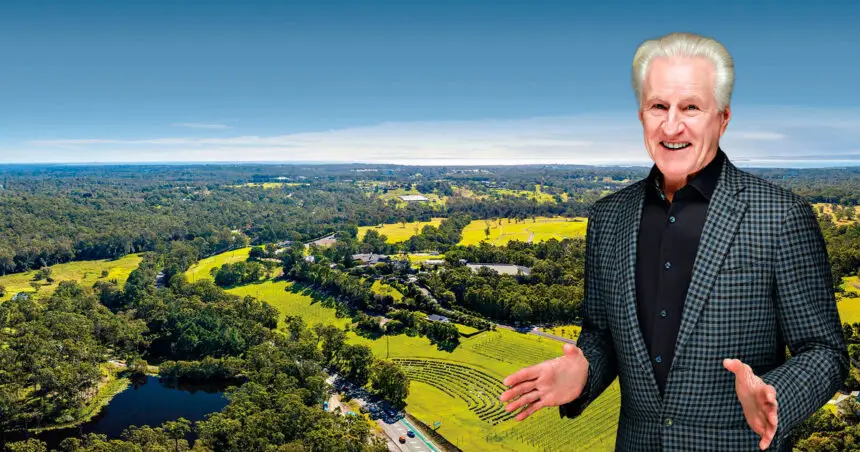
A FIVE-STAR resort, 18-hole golf course and luxury accommodation precinct at Sirromet could come before Redland City Council next year, but only if the State Government first brings the land inside South East Queensland’s urban footprint.
Developer Stephen Williams, best known for West Village in Brisbane, Ecco Ripley in Ipswich and Melrose Park in Sydney, is representing landowners around Sirromet Winery and the nearby chicken-processing precinct.
He told a packed public meeting he wanted to turn Sirromet into an international tourism drawcard before the 2032 Olympics.

But the project cannot proceed under the site’s current rural zoning.
Mr Williams said inclusion in the urban footprint was needed before formal development applications could be lodged with Council for a 250-room five-star hotel, golf course, villas, conference facilities, wellness retreat, huts and expanded glamping.
“PDA was one of the options that we were contemplating,” Mr Williams said.
“But I doubt that the State Government will see merit in introducing a PDA … given the reluctance by the State Government to override the decision-making of Council.”
He said his informal understanding was that a decision on new urban-footprint land could be made by December, with consultation and gazettal potentially completed by about June 2027.
“We would be aiming to get that approved and developed before the Olympics,” he said.
State Member for Redlands and Assistant Minister for Planning, Housing and Better Regulation Rebecca Young confirmed the developer had lodged a formal submission seeking urban-footprint inclusion.
“Even if the Urban Footprint were amended, that would not mean the developer could simply proceed with their proposed uses,” she said.
“The appropriate zoning, development assessment and community consultation processes would still need to occur.”
Division 7 councillor and Planning and Regulation portfolio holder Rowanne McKenzie said a PDA was unnecessary.
“Council has an experienced planning team that understands the needs of our city and is more than capable of working with landowners and community to deliver positive outcomes,” Cr McKenzie said.
Champion Redlands Coast CEO Cindy Corrie said the proposal could help grow a visitor economy that currently accounts for about $500 million, or 3.3 per cent, of the Redlands Coast’s $8 billion gross regional product.
“The plans for Sirromet look positive in the context of building our visitor economy and creating more reasons for people to stay and spend in the Redlands,” she said.
The Sirromet concept forms part of a broader Mount Cotton proposal involving land around Golden Cockerel and Darwalla poultry operations.
Potential uses include a technology or employment precinct, shops, health and community facilities, retirement living and possible housing.
However, Cr Peter Mitchell rejected ideas of another major detached-housing estate while up to 8000 homes were planned for Southern Thornlands.
Mr Williams said no decision had been made on housing.
“It could be that there are no residential uses that will ever eventuate there,” he said.
Residents raised concerns about traffic, chicken-processing odour, koala habitat and the loss of Mount Cotton’s rural identity.
“Mount Cotton is a unique part of the Redlands, and I understand why residents are passionate about protecting its rural character and lifestyle,” Mrs Young said.
“I recognise the concerns raised by residents about traffic, odour, environmental impacts and preserving Mount Cotton’s rural character.
“These are legitimate concerns that must be properly considered as part of any future planning process.”
Mr Williams said Mount Cotton Rd needed major upgrades regardless of the development.
Cr McKenzie said infrastructure costs could not fall to Redland ratepayers.
“All infrastructure requirements will need to be delivered and paid for by the proponents,” she said.
The future of Golden Cockerel’s wastewater treatment and odour was another flashpoint.
Mr Williams said reverse-osmosis technology could recycle about 60 per cent of water now discharged while treated water could be used on parkland and the golf course.
He understood that residents expected their concerns to be acknowledged and properly addressed by both the State and Council.
“After I had spoken, I had more than 10 people come up to me and express support,” Mr Williams said.
He said any development of cleared land adjoining koala habitat would trigger a five-times environmental offset.
For now, there is no approval and no guarantee the land will enter the urban footprint.
“If I don’t get an approval then I’m not doing anything,” Mr Williams said.