Facebook
Notification
Redland Bayside News
  • News & Editorial
  • Digital Editions
  • Pickup Locations
  • Advertise With Us
  • News & Editorial
  • Digital Editions
  • Pickup Locations
  • Advertise With Us
  • Digital Editions
  • Pickup Locations
Facebook
Notification
Redland Bayside News
  • News & Editorial
  • Digital Editions
  • Pickup Locations
  • Advertise With Us
  • News & Editorial
  • Digital Editions
  • Pickup Locations
  • Advertise With Us
  • Digital Editions
  • Pickup Locations
Redland Bayside News > Fishing > Estimating fish age
Fishing

Estimating fish age

Redland Bayside News
Published: November 28, 2024
Share
3 Min Read
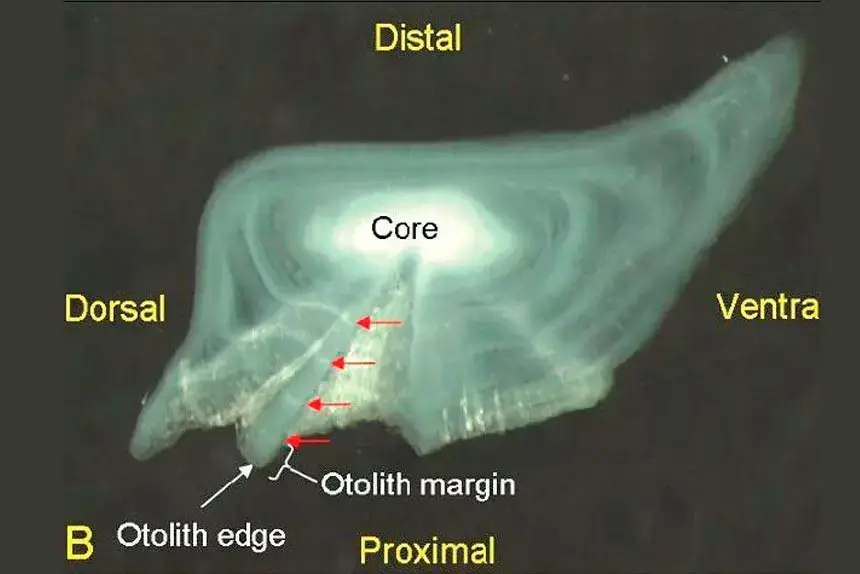
The otolith is used to determine the age of fish.
SHARE

IDENTIFYING how old fish are is fundamental to knowing how fast they grow, how old they are when they reproduce, and how long they live.

Contents
  • OTOLITHS ARE EAR BONES
  • HOW EAR BONES ARE USED TO ESTIMATE AGE
  • COUNTING OPAQUE BANDS
  • USING WHOLE OR SECTIONED EAR BONES

The Department of Agriculture and Fisheries uses this data to estimate the number of fish in different age groups and how this changes over time.

These details help the department assess the sustainability of fish stocks:

OTOLITHS ARE EAR BONES

Otoliths (ear bones) help fish orientate themselves and maintain balance, acting like our middle ear.

- Advertisement -

They are composed of a form of calcium carbonate and protein, which is deposited at different rates throughout a fish’s life.

This process leaves bands (alternating opaque and translucent bands) like the growth rings in a tree.

The otoliths are located within the skull behind the eye and directly below the brain. Otoliths come in different sizes and shapes depending on the species of fish. They can be slender and fragile (e.g. mackerel and cobia), large and chunky (e.g. barramundi and snapper) or symmetrical in shape (e.g. sand whiting).

HOW EAR BONES ARE USED TO ESTIMATE AGE

To estimate fish age, fisheries scientists examine the otoliths and count the number of opaque bands – like growth rings in a tree.

This information, plus the date the fish was caught, the birth date (middle of the species’ spawning period) and the period that opaque bands were deposited, are used to estimate the age of the fish.

COUNTING OPAQUE BANDS

Otoliths are interpreted by counting the number of opaque bands between the core and the edge, and measuring the otolith margin (the distance between the last opaque band and the otolith edge).

The width of the otolith margin tells us when the last opaque band was deposited.

USING WHOLE OR SECTIONED EAR BONES

Otoliths can be interpreted whole or they may need to be sectioned by cutting a thin slice from the otolith through the core.

Sectioning otoliths enables a clearer view of the banding patterns in some species.

Share This Article
Facebook Email Print

Latest Redlands News

WHAT ABOUT HIM: Shannon Noll will be a big part of the entertainment on offer at the travla Hoedown.
Shannon Noll set for Hoedown
Events Featured News
STAYING ALERT: The Golden Cockerel Chicken farm at Mount Cotton is monitoring the situation.
Bird flu warning for Bayside as MP calls for stronger biosecurity
Community Featured News
MOVING OUT: Young koalas are heading out on their own.
Young koalas on the move as danger season begins
Community
TUILEKUTU’S FOUR-TRY MASTERCLASS SEALS SEAGULLS’ VICTORY
Featured News Sport
ONGOING CONCERN: Residents continue to report repeated vandalism, late-night vehicle access, suspected alcohol and drug use in Thornlands Community Park.
Council ‘refuses’ safety funding as park vandalism concerns grow
Community Featured News
SAY CHEESE: Chicken Parmigiana at Redland Bay Hotel.
Is this Redlands and Bayside’s best parmi? We put it to the taste test
Ash's Apetite
EDUCATION: Beekeepers Ally and Steph, better known as The Girls in Pink, are educating the community on how to protect against varroa mites.
Deadly varroa mite putting squeeze on honey industry
Community Featured News

You Might Also Like

Colin Morgan loves the camaraderie of fishing with his friends.
Fishing

Lifetime of memories of fishing with mates

August 14, 2025
From voucher to vicarious thrill: fishing bug bites next generation
CommunityFeatured NewsFishing

From voucher to vicarious thrill: fishing bug bites next generation

January 24, 2026
FAMILY AFFAIR: The Thomsen family often competes in tournaments run by game fishing clubs across South East Queensland.
Fishing

Thomsen family love thrill of game fishing

March 22, 2026
Peter Stanley with a large mouth Nannygai fish. He said he had experienced many proud fishing moments.
Fishing

Fishing alone gives Peter time to think

November 28, 2024

Published by Local News Group QLD. Dedicated to connecting local communities through informative and engaging media.

  • Contact Us
  • Advertise With Us
  • Quick Links
  • Community
  • Featured News
  • Sport
  • Cleveland
  • Real Estate
  • Redland City Council
  • Seniors
  • Capalaba
  • Redlands
  • Business
  • Victoria Point
  • Redland Bay
  • Birkdale
  • Fishing
  • Entertainment
  • Wynnum
  • Wellington Point
  • Alexandra Hills
  • Finance
  • Disability News
Copyright © 2026 Local News Group - Website by LNG Digital
Welcome Back!

Sign in to your account

Username or Email Address
Password

Lost your password?