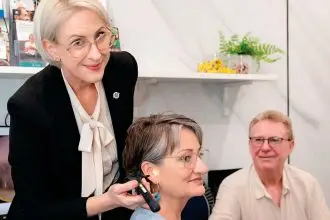


By Penelope Woods, MAudSt, MAudA (CCP), BMus, is a Masters Qualified Independent Audiologist and Hearing Health Advocate serving the community.
At a family lunch, you may hear the person beside you perfectly well, then lose half of what someone says from the other side of the table.
A few minutes later, you follow them again when the room quietens down.
That can feel inconsistent. It is not.

The important thing is not simply how loud a voice is. It is how clearly that voice stands out from everything else around it. Audiologists call this the signal-to-noise ratio.
Think of conversation as a race. In a quiet lounge room, the voice you want to hear has a big head start. At a cafe, bowls club or community lunch, the coffee machine, cutlery, chairs, music and other conversations are all running beside it. If the voice no longer has enough of a lead, speech becomes much harder to separate from the background.
Distance can make the problem worse surprisingly quickly. The person next to you may be easy to follow, while someone two or three seats away seems muffled. Their voice has become weaker by the time it reaches you, but much of the room noise is still there.
That is why changing seats can sometimes help more than simply asking everyone to speak louder.
The same thing happens in the car. The passenger beside you may be easy to hear, while someone in the back seat disappears beneath road and air conditioning noise.
At a family gathering, one grandchild speaking to you directly may be fine, but three grandchildren talking at once can turn into a jumble.
Here is a professional point that often surprises people. A standard hearing test is carried out in quiet and tells us how softly you can detect different sounds. It is important, but it cannot fully show how you cope when speech and noise compete. A speech-in-noise test can measure how much the speech needs to stand out from the background for you to understand it.
At A Better Ear, an independent hearing rehabilitation clinic serving the Redlands community, our clinical team uses this sort of information alongside the hearing test and, just as importantly, the situations people describe from everyday life.
If busy places are where hearing falls apart, try a small experiment before your next lunch. Sit closer to the people you most want to hear. Choose a quieter edge of the room if you can. A seat with your back to a wall can make the listening job easier.
Then notice what changes.
That information can tell you far more than simply saying, “My hearing seems fine at home.”