
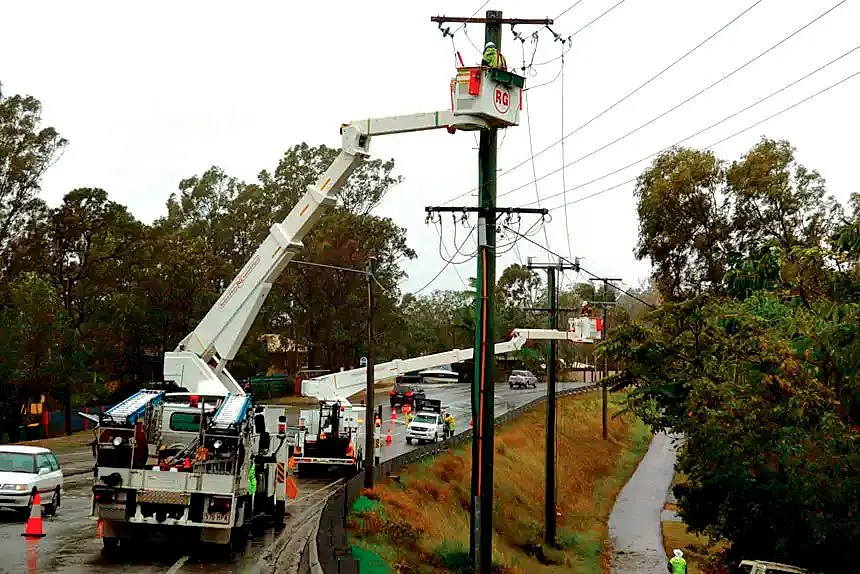
A LONG-RUNNING dispute over electricity charges on Russell Island is raising questions about whether residents are being forced to pay twice for infrastructure already funded by ratepayers nearly three decades ago.
At the centre of the issue is a 1995 agreement under which the former Redland Shire paid $7.816 million to South East Queensland Electricity Corporation (SEQEB), now Energex, to provide reticulated power to eligible residential lots on the island through to the end of 2050.
Residents and Cr Shane Rendalls argue Energex is now charging assessment fees for network extensions that should already be covered under that agreement.
Under the deal, Redland Shire paid the corporation in 10 annual instalments of $781,600 between 1996 and 2001.
In return, SEQEB agreed to make electricity available to existing approved allotments in accordance with the terms of the contract.

Redland City Council confirmed a special charge adopted by Council was applied to identified Russell Island properties until 2001 in connection with the agreement for the supply of electricity to the island.
A Council spokesperson said the local authority was now discussing the matter with Energex following concerns raised by residents.
“Council is currently in discussions with the electricity distributor in relation to this matter and concerns raised by residents regarding costs applied by the distributor,” the spokesperson said.
Residents challenging the charges argue the wording of the agreement leaves little room for Energex to impose additional costs on applicants for standard 240-volt domestic supply.
The agreement contains no reference to assessment fees, planning fees or similar charges now being levied.
Cr Rendalls said he first became aware of the issue in August 2025 after being contacted by residents concerned about costs associated with extending reticulated supply along their street.
According to Cr Rendalls, the first resident seeking connection in an unreticulated section of road was often being charged for the infrastructure, while later properties could benefit from the same network extension without paying the same costs.
Cr Rendalls said the issue was not the standard cost of connecting a dwelling to existing power, but charges relating to extending the reticulated street network itself.
“For me the issue is very simple,” he said.
“Energex should honour the contract moving forward and reimburse all residents charged this fee.”
Nine months later, Cr Rendalls said the matter remained unresolved, although he acknowledged both Council and Energex now recognised the agreement remained in force until 2050 and were engaged in discussions over its interpretation.
Energex confirmed it was reviewing the arrangement with Council, but maintained that connection services remained subject to modern regulatory requirements.
An Energex spokesperson said the company could not comment on individual customer charges.
“We are engaging with Redland City Council to review the agreement in the context of the current regulatory framework to ensure a clear, contemporary understanding moving forward, with discussions ongoing.
“As a regulated entity, the distribution services provided by Energex (including connection services) are subject to economic regulation.
“The framework for connecting customers and determining associated charges are set out in the National Electricity Rules, with which Energex is required to comply.”
The position appears at odds with the interpretation advanced by Cr Rendalls and affected residents, who argue the 1995 agreement already covered the costs associated with extending reticulated electricity infrastructure to approved residential lots.
Russell Island resident Phillip O’Sullivan claimed he was charged thousands of dollars despite existing infrastructure located nearby.
“I paid Energex $2640 to get the poles to my property. The nearest property in my residential street with power is 18.5 metres away,” he said.
Mr O’Sullivan alleged he was later asked to sign a lengthy agreement relating to the infrastructure works.
“After they got my money, they then tried to force me to sign a 20-page contract with them,” he said.
“I cannot legally contract with anyone, let alone an electrical infrastructure company, to build on land neither of us own.
“It would make me responsible for those works.”
Mr O’Sullivan claimed there was approximately 250 metres of missing electrical infrastructure in the middle of his street, and alleged multiple agencies had failed to properly address the issue.
He said he had not received a refund after declining to sign the agreement.
Cr Rendalls questioned how assessment fees could be justified when planning for the network should already have been completed under the original agreement.
“Energex would already know the placement and number of poles and location to cover each approved residential lot on a street-by-street basis,” he said.
“To add further insult, there are now significantly fewer residential lots than there were in 1995 due to Council buybacks over the subsequent years.
“Energex was overpaid then and they are wanting to underdeliver now.”
Cr Rendalls said the issue affected both new residents and long-term ratepayers who contributed to the original funding arrangement.
“My community is being ripped off,” he said.
“This is unfair to new residents and all ratepayers who contributed to the $7,816,000 paid between 1996 and 2001.
“Energex should deliver what they agreed to deliver or refund all the money paid by Council, indexed to 2050 pricing.”
The dispute has expanded beyond the fee itself to the contracts residents are reportedly being asked to sign before power is connected.
Cr Rendalls said Energex was waiving connection fees in those agreements but argued the broader terms-imposed obligations that should not apply to ordinary residents seeking standard domestic supply under an existing Council agreement.
Among his concerns were provisions relating to easement approvals, Council landowner consent and requirements for residents to hold $20 million public liability insurance.
“I suspect the contract may be in breach of the Australian Securities and Investments Commission (ASIC) unfair contract terms,” he said.
With population growth continuing, Cr Rendalls believes the problem is likely to affect many more households unless it is resolved quickly.