
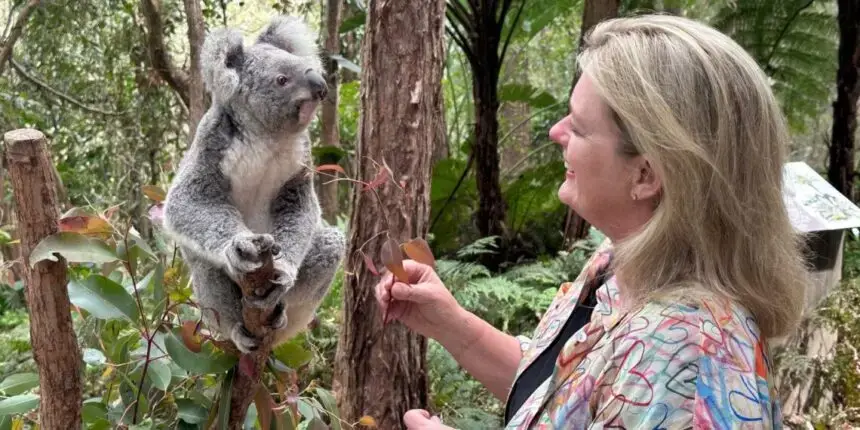
REDLAND City Council is set to call for stronger habitat protections, better mapping, more funding and tougher oversight of land clearing as it prepares to lodge a submission on Queensland’s proposed new koala conservation strategy.
At next week’s general meeting, councillors will consider whether to endorse a submission to the Department of Environment, Tourism, Science and Innovation on the Draft South East Queensland Koala Conservation Strategy 2026–2036.
While the officer recommendation is for council to back the submission, the attached feedback from council officers makes clear Redlands wants a far more ambitious and better resourced state response if koala populations are to recover.
Council officers say the previous SEQ Koala Conservation Strategy 2020–2025 lacked a clear landscape-scale vision and did not provide local governments with enough clarity, funding or tools to deliver meaningful outcomes.

In their submission, officers argue the new 10-year strategy must give the state a stronger leadership role, with DETSI acting as the strategic provider of habitat and vegetation mapping, koala reporting systems and consistent monitoring standards across South East Queensland.
They also say the new strategy must include direct funding and resources for councils, researchers and delivery partners, including support for both short-term projects and longer-term work needed to gather ecologically meaningful data.
“The new SEQ Koala Conservation Strategy 2026–2036 must significantly improve mechanisms to provide direct funding and/or resources to LGAs and other stakeholders,” the officer feedback states.
Officers have also urged the state to adopt a tougher conservation goal, saying the policy aim across all planning and regulatory instruments should be “net gain” of koala habitat, not merely “no net loss.”
That position goes to the heart of one of the most contentious questions in the state consultation: how to balance koala protection with housing supply in one of Australia’s fastest-growing regions.
Council officers say the two objectives are not incompatible, but only if growth is managed through smarter planning that avoids habitat destruction and protects connected conservation areas over the long term.
They argue South East Queensland’s koala strategy should work to a 50-year vision, with five to 10-year review cycles, to account for population growth, urban expansion and climate pressures.
On habitat targets, officers reject the idea of a simple one-size-fits-all number and instead propose what they describe as a “balanced scorecard approach” combining habitat protection, improvement, restoration and expansion depending on local conditions.
The submission also raises concerns about how threats to koalas are being managed and measured.
Council officers say there is no single solution to reducing koala deaths, with the main dangers varying from area to area, including vehicle strikes, dog attacks, disease and habitat fragmentation.
But they are sharply critical of some current monitoring methods, arguing DETSI’s distance sampling surveys do not provide sufficiently meaningful data on koala populations or habitat condition.
Instead, they want more detailed and scientifically robust assessments, including drone-based thermal imaging, habitat studies, koala scat surveys and genetic analysis to better understand population structure, health and movement.
Redlands officers are also calling for improvements to state mapping, particularly in urban areas where isolated feed trees, park vegetation, road reserves and other “stepping-stone” habitat can be vital for koala movement but may not be adequately protected under current mapping systems.
They say the state’s methodology focuses too heavily on large connected habitat areas and risks overlooking the fragmented reality faced by many urban koala populations.
That concern is echoed in council’s response to proposed regulatory changes now under review.
Officers oppose a proposal to increase exempt clearing on lots larger than one hectare from 500 square metres to 800 square metres, saying no evidence has been provided to justify the change and warning it would allow more habitat loss.
In fact, council officers say they would prefer the exempt clearing threshold to be cut from 500 square metres to 250 square metres, with any clearing between 250 and 500 square metres made assessable and anything above 500 square metres remaining prohibited within a Koala Priority Area.
They also warn the current framework relies too heavily on landowners self-managing exempt clearing, with limited compliance monitoring to ensure habitat is not being removed excessively or inappropriately.
Among other points, officers support tighter rules around cumulative use of exemptions in principle, back changes to address consequential clearing after initial approvals, and want stronger protections for individual eucalypts and stepping-stone habitat in urban landscapes.
The submission also pushes for greater involvement of Traditional Owners and First Nations rangers in koala monitoring, better use of research and innovation, and new funding models that could attract corporate investment into koala conservation projects.
Officers say councils are often best placed to deliver community education and place-based conservation work because they understand local threats, local landscapes and community expectations in a way the state cannot replicate on its own.
Redland City has long been regarded as a key koala area, but council’s own report notes koala numbers in the Koala Coast, including Redland City, declined by around 80 per cent between 1996 and 2014.
If councillors endorse the submission next week, the Chief Executive Officer will be authorised to formally lodge council’s response with the state government as consultation on the new strategy continues.
The agenda item is likely to attract close attention from residents and conservation groups, with the koala remaining one of the Redlands’ most iconic — and politically sensitive — species.