
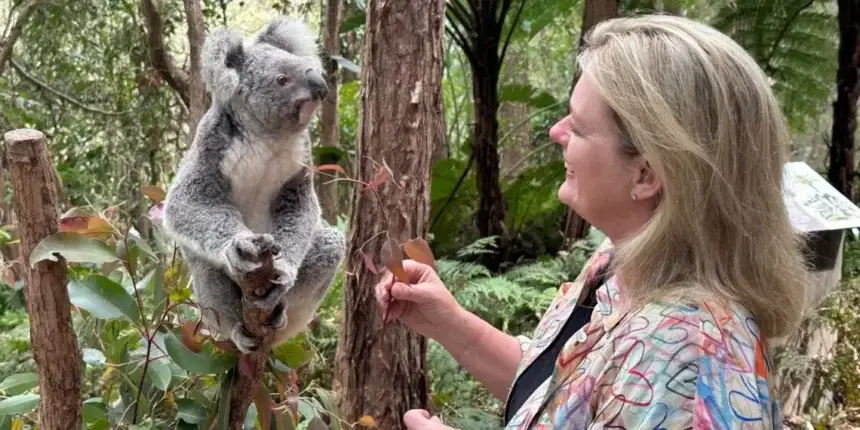
REDLAND City Mayor Jos Mitchell has declined to attach her name to a council media release on koala conservation, instead delegating the announcement to Deputy Mayor Julie Talty following a divisive chamber debate.
It is understood the Mayor declined to endorse the public statement after voting against the amended submission to the State Government’s South East Queensland Koala Conservation Strategy 2026–2036.
Council last week confirmed it would lodge its submission, with Cr Talty fronting the media release and calling for clearer State responsibility and funding commitments.
“Investments made by Council in science-based conservation, innovative technology and community engagement and education have contributed to a stabilised koala population at this time on Redlands Coast,” Cr Talty said.

“The wealth of work and data Council has compiled through its Koala Conservation Program initiatives is available to the Queensland Government and would be invaluable for its proposed strategy.
“Council also believes the strategy must significantly improve how the State provides direct funding and resources to Councils and other stakeholders.
“There needs to be direct funding for both short-term and long-term koala research, reporting, monitoring and other data capturing.
“Local Government Areas (LGA) are best placed to understand community expectations, values, and local threats.
“Providing LGAs with greater funding autonomy and resources would enhance the reach and impact of conservation messaging and action.
“Council is also stressing that strong policies are essential for south-east Queensland’s koalas’ survival in a highly urbanised region.”
The submission was endorsed at last week’s General Meeting and will now be lodged with the Department of Environment, Tourism, Science and Innovation.
However, the united front presented in the media release contrasts sharply with last week’s heated council meeting, where the Mayor was among four councillors to vote against the amended submission.
During that debate, Mayor Mitchell repeatedly questioned why officer-backed scientific content had been removed from the document.
“On pages 9, 11, 12 and 13, large sections have been struck out. Can you explain why officer recommendations… have been removed?” she asked.
She later added: “So just to clarify for the record — I’ve asked two questions and they have not been answered.”
Cr Talty, who defended the amended submission, said changes reflected councillor input but declined to detail who made specific edits.
“I would suggest that councillors who do not support particular statements in the submission have removed those statements accordingly,” she said.
The debate also revealed concerns about the removal of references to First Nations land management practices and possible changes to vegetation clearing thresholds.
Cr Paul Bishop warned the changes risked undermining years of scientific work.
“When we depart from expert, data-driven advice — particularly in complex ecological systems — we’re increasing the risk of unintended consequences that might not be easily reversed,” he said.
Despite those concerns, the submission passed 7–4.
Council’s response addresses a State discussion paper outlining four key priorities: protecting and restoring habitat, reducing threats, working together, and improving monitoring and data.
Further consultation is expected once a draft strategy is released.