Facebook
Notification
Redland Bayside News
  • News & Editorial
  • Digital Editions
  • Pickup Locations
  • Advertise With Us
  • News & Editorial
  • Digital Editions
  • Pickup Locations
  • Advertise With Us
  • Digital Editions
  • Pickup Locations
Facebook
Notification
Redland Bayside News
  • News & Editorial
  • Digital Editions
  • Pickup Locations
  • Advertise With Us
  • News & Editorial
  • Digital Editions
  • Pickup Locations
  • Advertise With Us
  • Digital Editions
  • Pickup Locations
Redland Bayside News > Fishing > Estimating fish age
Fishing

Estimating fish age

Redland Bayside News
Published: November 28, 2024
Share
3 Min Read
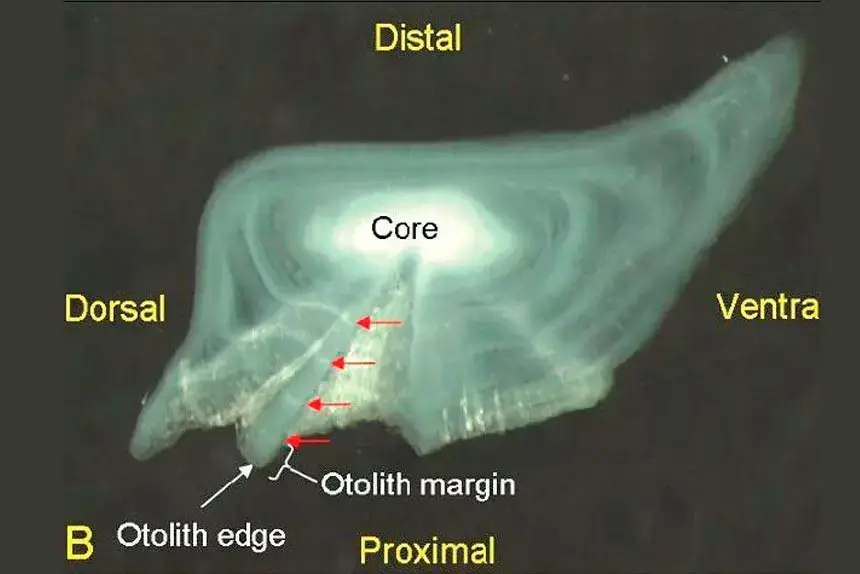
The otolith is used to determine the age of fish.
SHARE

IDENTIFYING how old fish are is fundamental to knowing how fast they grow, how old they are when they reproduce, and how long they live.

Contents
  • OTOLITHS ARE EAR BONES
  • HOW EAR BONES ARE USED TO ESTIMATE AGE
  • COUNTING OPAQUE BANDS
  • USING WHOLE OR SECTIONED EAR BONES

The Department of Agriculture and Fisheries uses this data to estimate the number of fish in different age groups and how this changes over time.

These details help the department assess the sustainability of fish stocks:

OTOLITHS ARE EAR BONES

Otoliths (ear bones) help fish orientate themselves and maintain balance, acting like our middle ear.

- Advertisement -

They are composed of a form of calcium carbonate and protein, which is deposited at different rates throughout a fish’s life.

This process leaves bands (alternating opaque and translucent bands) like the growth rings in a tree.

The otoliths are located within the skull behind the eye and directly below the brain. Otoliths come in different sizes and shapes depending on the species of fish. They can be slender and fragile (e.g. mackerel and cobia), large and chunky (e.g. barramundi and snapper) or symmetrical in shape (e.g. sand whiting).

HOW EAR BONES ARE USED TO ESTIMATE AGE

To estimate fish age, fisheries scientists examine the otoliths and count the number of opaque bands – like growth rings in a tree.

This information, plus the date the fish was caught, the birth date (middle of the species’ spawning period) and the period that opaque bands were deposited, are used to estimate the age of the fish.

COUNTING OPAQUE BANDS

Otoliths are interpreted by counting the number of opaque bands between the core and the edge, and measuring the otolith margin (the distance between the last opaque band and the otolith edge).

The width of the otolith margin tells us when the last opaque band was deposited.

USING WHOLE OR SECTIONED EAR BONES

Otoliths can be interpreted whole or they may need to be sectioned by cutting a thin slice from the otolith through the core.

Sectioning otoliths enables a clearer view of the banding patterns in some species.

Share This Article
Facebook Email Print

Latest Redlands News

The Weinam Street Jetty will close for an extended period.
Redland Bay Jetty closed for repairs
Community
Dementia Australia and Masters Games Promote Brain Health
Sporting spirit helping to tackle dementia one game at a time
Health
NOT NEGOTIABLE: It is more important than ever that policymakers support housing investment and development by reducing the costs of home building.
Detached house approvals still picking up despite Budget blow
Real Estate
Build Strong Financial Foundations Before You Need Them
The invisible systems that keep life running
Finance
FUNDING BOOST: Round 1 sponsorship recipients Redland City FC will install much-needed shade for families and spectators.
Funding up for grabs as sponsorships reopen
Community
Queensland Junior State Cup Ends in Redlands
Junior State Cup wraps up after three days of outstanding Touch
Sport
COUNCIL QUERIES: Concept images for the proposed Bayside Pavilion at 18 Fox St, Wynnum, which is under scrutiny from Brisbane City Council.
Council demands answers on 20 issues for $25m Wynnum plan
Community

You Might Also Like

Allan Dryden with a snapper caught at Wynnum.
Fishing

Father-son bonding leads to fishing trips

February 27, 2025
This image from 1909 suggests there were no limits in place back then.
Fishing

Historic barramundi catch highlights just how far fishing has come

June 19, 2025
Friends Julie Bates and Lyndy Pennisi with a few nights’ dinner caught off Great Keppell Island.
Fishing

Fishing trip brings fun memories and dinner

August 28, 2025
ON THE WATER: Jane MacDougall, pictured here with a whiting, is this week’s featured angler.
Fishing

Coochie a favourite spot for Redlands anglers

June 29, 2023

Published by Local News Group QLD. Dedicated to connecting local communities through informative and engaging media.

  • Contact Us
  • Advertise With Us
  • Quick Links
  • Community
  • Featured News
  • Sport
  • Cleveland
  • Real Estate
  • Redland City Council
  • Seniors
  • Capalaba
  • Redlands
  • Business
  • Victoria Point
  • Redland Bay
  • Birkdale
  • Fishing
  • Entertainment
  • Wynnum
  • Wellington Point
  • Alexandra Hills
  • Finance
  • Disability News
Copyright © 2026 Local News Group - Website by LNG Digital
Welcome Back!

Sign in to your account

Username or Email Address
Password

Lost your password?