
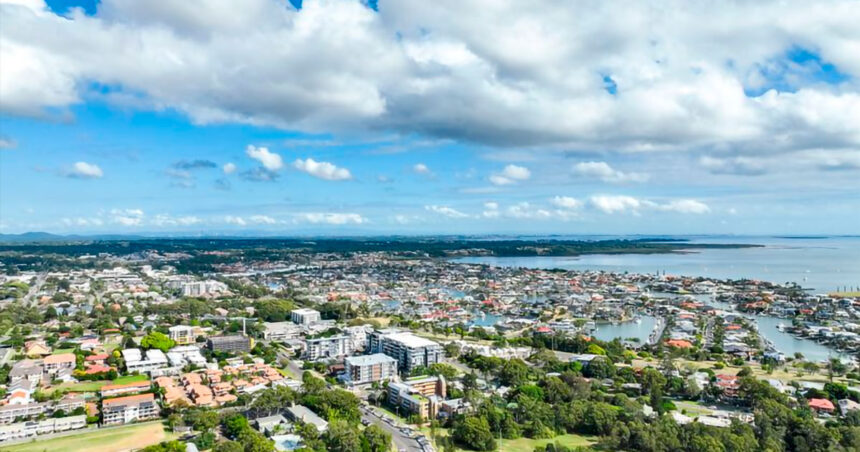
IN 1842, the former penal colony of Brisbane Town and its surrounds were opened to free settlers.
As well as immigrants from overseas, pastoralists flocked up from inland grazing areas.
After settlement of the Ipswich area and beyond, the leader of the pastoralists there, Francis Bigge, supervised the building of a road from Ipswich, along which they sent their wool to the stores on Cleveland Point for shipping overseas.
So confident was Francis Bigge in the future of Cleveland that he built an inn on the high ground overlooking the point in 1849, and a timber mill on the point itself.

His enthusiasm was not shared by many, and the eminent Dr Lang in 1853 even dubbed the hotel ‘Bigge’s Folly’, a name that was soon to prove an omen.
For Cleveland’s aspirations as a port were dealt several blows, the first had been the visit of Governor Gipps in 1842.
His arrival, by ship, unfortunately coincided with a low tide and he was forced to wade ashore through an expanse of mud.
The wreck of the Sovereign in 1847 and of the barque Countess of Derby in 1853 on the South Passage Bar convinced captains to use the longer, but safer, entrance to Brisbane via the North West Channel between Bribie and Moreton Islands.
The burning of the brig Courier while moored with a cargo of oil and wool off Cleveland Point on the night of January 16, 1854 was the final nail in the coffin of Cleveland’s aspirations as a port.
Although the Port was disbanded, Bigge’s Folly remains still as the Grand View Hotel.
John Cassim was the first publican in the district.
He conducted the Grand View for Francis Bigge prior to building his own Cassim’s Hotel next door in about 1860.
The graves of John and his wife Mary are to be found in the picturesque cemetery at the One Mile on Minjerribah (Stradbroke Island).
Another of Queensland’s pioneers was William Eugene Finucane, and his name has been preserved by naming the road that links Capalaba and Cleveland after him.
But he deserves to be remembered for much more than this.
As Queensland’s Trade Commissioner, William Finucane was a multi linguist, an artist, sculptor, journalist, and musician (today he would be known as a polymath).
Incidentally, the name “Cleveland” emerged during the early years of European settlement.
While the exact origin of the name is debated, it is often linked to either William Vane, first Duke of Cleveland, or to John Cleveland, a former Secretary of the Admiralty.