FOR much of his early working life, Jarad Danby knew there was something else he wanted to be doing, but it was not until the age of 27 that the former tradesman decided to return to the creative passion he had largely left behind as a teenager growing up in Ormiston.
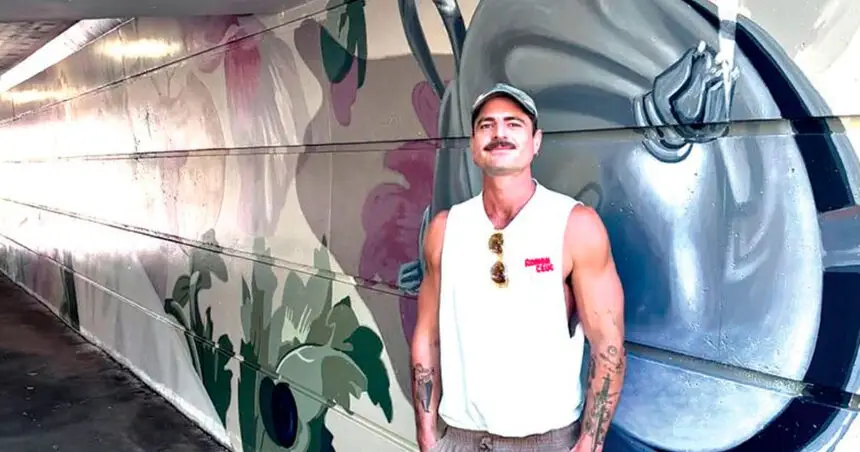
Almost a decade later, the self-taught artist is producing large-scale public artworks across Queensland and beyond, transforming walls into murals designed to reflect the history, character and communities surrounding them.
“Whenever I had a moment to myself, I would just draw on anything I could, like a receipt that was laying around or the back of a napkin or just anything,” he said.
“It was just always something I felt compelled to do.”

At 27, he decided to teach himself how to paint, developing his own curriculum and dedicating an hour every afternoon for studying and practising.
“I thought, you know what, I’m ready to try to do a painting. I did one. It sucked,” he said.
“I did another. I probably did 10 more and they all sucked.
“But, you know, sooner or later, the suck-to-good ratio sort of evened out a little bit.”
After meeting other artists working in large-scale murals, including James Ellis, Danby began transferring what he had learned on canvas onto walls, and travelled through regional Queensland and New South Wales to paint.
“I always knew that there was more, you know, and that I could be happy in my career and I could feel fulfilled,” he said.
“When I achieved that and I started painting for a job, it just felt like a piece of the puzzle and everything in my life just got better.
“I genuinely think it made me a better person. It just made me more positive and more disciplined and just more dedicated.”
Building a career as an artist, however, came with significant sacrifices as Danby spent almost six years living in a caravan and travelling from project to project, often spending long stretches away from family and friends.
“A lot of it was miserable, to be honest,” he said.
“But I was doing what I wanted to do and I was just putting pieces into that puzzle and just kind of building a foundation.
“If you want to be successful at it, or even get reasonably competent at anything, you have to be willing to make sacrifices.”
Those years spent working in different towns also helped shape Danby’s approach to public art, which he believes should have a genuine connection to the people and places surrounding it rather than simply reflect an artist’s personal vision.
“Public art is for the public, so you have to find that sort of sweet spot where what you want to do aligns with what people want to see and what people find meaningful,” he said.
“A good way to do that is to just engage with stakeholders, just hang out with people, just get a feel for the place.”
A keen student of history, Danby said he researched the places in which he worked and spoke with locals to understand what made each community distinctive before developing his concepts.
“If you’re a mural artist, or any artist for that matter, you’ve always got ideas ticking around in your head and concepts that you’re exploring,” he said.
“A lot of the time, you’ll just arrive to a wall and you’ll think, damn, that thing I’ve been contemplating or thinking about will fit this perfectly.
“The cogs are always turning.”
Danby said greater trust between commissioners and artists was allowing public art to move beyond some of the familiar formulas that had dominated the sector.
“Artists are getting maybe a tiny bit more creative freedom in recent years, which is a super good thing,” he said.
“You don’t commit your whole life to something so you can just become a conduit for someone else’s ideas.”
Among those advocating for more opportunities in the sector is street-art consultant Matt Tervo, who Danby met at a Brisbane event about five years ago before the pair developed a friendship and professional relationship.
Danby said Tervo’s work had helped create opportunities for artists, including his own first public artwork in Brisbane at Breakfast Creek.
“What he’s doing at the moment for the Brisbane wider community is great,” Danby said.
“I’m certainly getting some great opportunities thanks to him.”
Despite spending years travelling for his work, Danby keeps strong links to South East Queensland and his Redlands upbringing.
“I just want to create paintings that I’m passionate about and share them in a way that’s meaningful,” he said.