
IT’S been a fascinating start to this World Cup, and if I’m being honest, it’s felt like a tournament that hasn’t quite exploded into life yet – but that’s not a criticism.
It’s just the reality of how teams are approaching it.
What you’re seeing in these opening matches is caution.
Loads of caution.

Nobody wants to lose the first game.
With the expanded format and the safety net of additional qualification places, the first objective for most teams is simple: don’t get beaten.
That naturally leads to tight, cagey games where margins are small and risk is limited.
And yet, within that, there’s still been some interesting football.
From a tactical point of view, I’ve been impressed by how well organised some sides are without the ball.
Morocco stood out to me, particularly in their game against Brazil.
They looked comfortable playing through the middle, especially in the first half, and they were brave in how they approached the game.
That’s not easy against elite opposition, but they were clearly well prepared and well drilled.
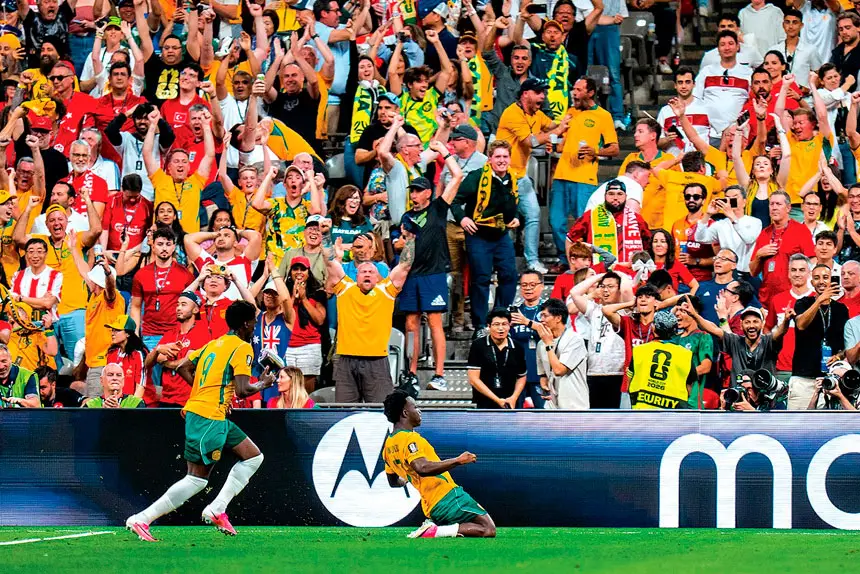
Australia also deserve a lot of credit for how they approached their opening match.
Their 2-0 win over Turkey was a mature performance.
It wasn’t flashy, but it was controlled, disciplined, and executed exactly as planned.
When you set up in a low block with a back five and midfield four, it’s not just about shape – it’s about concentration.
You can’t switch off for a second.
I thought the Socceroos were excellent in that regard.
There’s a tendency to underestimate how difficult that kind of performance is to produce.
People will talk about systems, but the real key is buy-in.
Players must fully accept the role they’re being asked to play.
There’s always a temptation, especially at this level, for players to become frustrated if they’re asked to sit deep and defend for long periods.
But Australia looked completely committed to the plan, and that comes from the coaching staff being
clear about roles and expectations – and the players trusting it.
You also must trust your goalkeeper in those situations, and I thought the decision to go with Patrick Beach paid off.
Big calls like that define tournaments, and when they come off, they reinforce the entire structure of the team.
What stood out most about Australia, though, was their game management.
They didn’t just defend – they defended with purpose.
When they won the ball, they knew exactly what they wanted to do with it.
There was no unnecessary risk, no forced build-up through areas where they didn’t have control.
Instead, they used the pace they have in advanced areas and played directly into space when it was on.
That clarity is what separates well-organised teams from chaotic ones.
We saw a similar contrast in another match when comparing approaches – one team trying to play out through midfield under pressure and getting punished, while another kept things simple and effective.
At this level, if you don’t have the players to execute a certain style under pressure, you can get exposed very quickly.
That brings me to a broader trend I’ve noticed in this tournament so far.
A lot of teams are still very comfortable giving up wide areas defensively.
The priority is protecting the central zones, blocking passes through midfield, and forcing play outside.
It’s a modern approach, but it also means you’re seeing more crosses, more second balls, and more emphasis on defensive organisation inside the box.
We’re also seeing plenty of hybrid systems – back threes in possession, back fives out of it.
That fluidity is now standard at international level.
It’s less about fixed formations and more about moments of the game.
Another factor that can’t be ignored is the physical load.
As the tournament progresses, squad depth is going to matter more.
With longer matches, added injury time, and the intensity of the schedule, you’re effectively playing “four quarters” rather than two halves.
That has an impact not only on fatigue but on injury risk as well.
Coaches will need to rotate, and third group games will become strategic – not just about winning, but about shaping the path through the knockout rounds.
From Australia’s perspective, that opening win does more than just give them three points.
It gives them clarity.
When you win your first game in a tournament, especially with a clean sheet, it validates everything you’ve worked on.
It builds trust in the system.
I’d expect that result to give the group real confidence going forward.
If they maintain that level of organisation, there’s no reason they can’t progress.
In these tournaments, especially now, it’s often the most disciplined defensive teams that find a way to stay alive longer than expected.
Looking ahead, what we do know is that physicality, structure, and squad depth are going to matter just as much as attacking quality.