
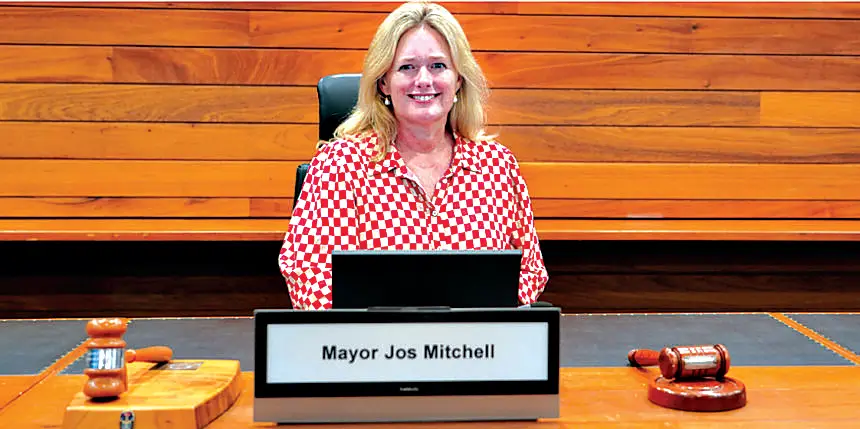
THERE should always be compassion when a public official steps away for health reasons.
Nobody should trivialise genuine medical concerns, and Mayor Jos Mitchell deserves the privacy and dignity any person would expect while dealing with a health issue.
But equally, the Redlands community has a right to ask legitimate questions about governance, leadership and timing.
Because this latest six-week leave does not occur in isolation.

It comes after an earlier extended absence earlier this year following the Mayor collapsing at work.
It comes amid months of political dysfunction, public infighting, record levels of councillor conduct complaints, repeated allegations of bullying and harassment, and ongoing State Government intervention through an appointed governance adviser.
And it comes at a particularly significant moment right as the governance adviser’s term approaches its conclusion.
That timing will inevitably fuel speculation across the community.
Residents are already openly asking whether this leave is connected to what may emerge from the adviser’s final report to the State Government.
Others question whether Redland City Council can continue functioning effectively while leadership instability persists.
Those questions are not unreasonable.
The role of mayor is one of the most senior public offices in local government.
It carries immense responsibility, scrutiny and accountability.
When a mayor is repeatedly absent during periods of major political turmoil, the public is entitled to ask whether the current situation is sustainable.
What Redlands cannot afford is continued uncertainty.
For months the city has been dominated by political warfare instead of progress.
The headlines have centred on complaints, investigations, governance concerns, public accusations, fractured relationships and dysfunction inside council chambers.
Meanwhile, residents simply want roads fixed, development decisions made, community services delivered and infrastructure projects progressed.
The Mayor herself recently launched a public campaign calling for better behaviour in politics through her “Raise the Bar” initiative.
Yet almost immediately afterwards, the community witnessed another eruption of division, accusations and public commentary from all sides after she claimed she was treated inappropriately at an unspecified public meeting.
That contradiction has only deepened community frustration.
The State Government did not appoint a governance adviser to Redlands because everything was functioning smoothly.
It intervened because concerns existed about council’s ability to operate effectively and the mayor’s ability to lead.
The key question now is whether conditions have deteriorated even further.
Importantly, asking these questions is not the same as attacking someone personally or dismissing legitimate health issues.
The community can wish the Mayor well while still demanding accountability and transparency from its elected leadership.
Both things can be true at once.
What happens next matters enormously.
If this leave genuinely allows the Mayor to recover and return capable of restoring stability and confidence, the community will welcome that outcome.
But if the instability, division and dysfunction continue, then the conversation about leadership — and whether Redlands needs a reset — will only grow louder.
Right now, many residents are no longer asking whether there is a crisis at Redland City Council.
They are asking who is actually in charge.