
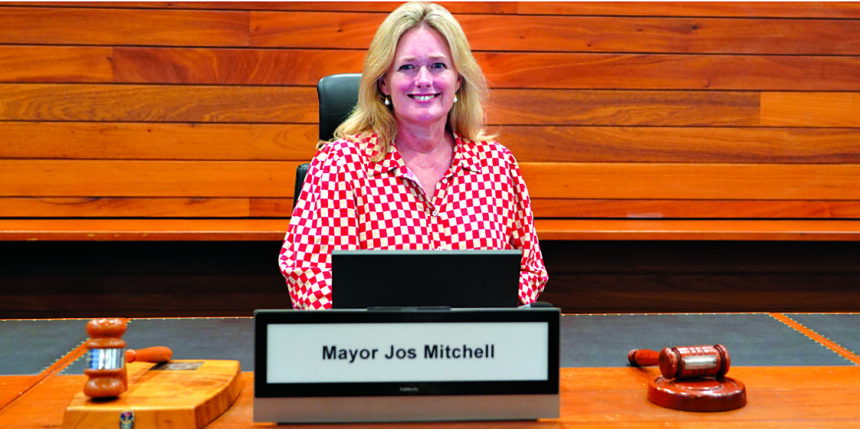
TWO years after sweeping into office on a promise to “Lead Change”, Jos Mitchell has reached the halfway point of her four-year term leading Redland City Council.
Mitchell was elected in March 2024 after a 14-month grassroots campaign, securing more than 50 per cent of first preference votes to claim a decisive victory in the mayoral race.
She finished well ahead of former federal MP Andrew Laming and community candidate Cindy Corrie.
The election followed what Mitchell described as one of the toughest campaigns in the state, including legal action in the final days of the race over campaign material she said misrepresented her political views.

Even before taking office, she foreshadowed potential tensions inside the council chamber.
“I face the very real possibility of going into a hostile council,” she said following her victory.
“Change is very hard for some, and it takes time, but the focus must be on delivering for the community.”
Mitchell’s path to the mayoralty came after a varied career spanning policing, business and community development.
She spent more than a decade with the Queensland Police Service working as a general duties officer, police prosecutor and regional training officer in metropolitan Brisbane and Central Queensland.
She later co-founded a regional photographic and design business serving national and international clients, before working in local government in New South Wales as manager of Sustainable Communities overseeing economic development, tourism, grants, libraries and youth services.
In 2018 she became a nationally accredited mediator specialising in workplace conflict and organisational culture.
Since taking office, Mitchell’s mayoralty has unfolded in a politically charged environment, with council meetings frequently marked by sharp debate and divisions among councillors.
Governance disputes and conduct complaints have become a recurring feature of the council’s political landscape, with Mitchell among those who have publicly questioned aspects of Queensland’s councillor complaints system and how it operates in practice.
The first half of the term has also coincided with significant turnover within council’s executive leadership, including the departure of the chief executive officer and other members of the executive leadership team, a situation critics argue has contributed to instability within the organisation.
Mitchell has also faced criticism over a lack of a clearly articulated long-term strategic vision for the city.
Other points of contention have included the appointment of a governance advisor, with critics noting that the terms of reference for the role were largely centred on matters involving the mayor.
Mitchell has also initiated legal action against council’s Executive Group Manager of Governance and Legal Services, Andrew Ross, a move that has drawn scrutiny and further fuelled political tensions within the organisation.
Attendance records have also been raised by critics, who point to several council workshops and briefings where the mayor participated online rather than in person.
Debate has also surrounded Mitchell’s decision not to support key corporate documents, including the 2025-26 council budget and the 2024-25 annual report, decisions that drew criticism from some councillors who argued the mayor should support major governance and financial documents.
Supporters of Mitchell argue her focus has been on improving governance processes and organisational culture within council before pursuing broader structural reforms.
Political leadership, however, is rarely just about winning elections.
In councils where every councillor holds an equal vote, mayors often need to persuade rather than command.
Even leaders without a reliable majority can still drive agendas by building alliances, negotiating compromises and bringing colleagues with them on key decisions.
Australian politics offers several examples.
Former prime minister Julia Gillard governed in minority from 2010 to 2013 yet managed to pass major reforms including the National Disability Insurance Scheme and the carbon pricing framework through careful negotiation with crossbench MPs.
At state and local levels, leaders frequently find themselves navigating divided chambers, relying on consensus-building rather than numbers alone to progress their priorities.
In that environment, the ability to forge working relationships across political divides can become one of the defining tests of true leadership.
With two years remaining before the next local government election, Mitchell now enters the second half of her term facing the challenge of translating her campaign promise of change into tangible outcomes for residents.
Whether the focus shifts toward policy delivery and long-term planning, or remains dominated by internal political conflict, will likely shape how her mayoralty is ultimately judged.