
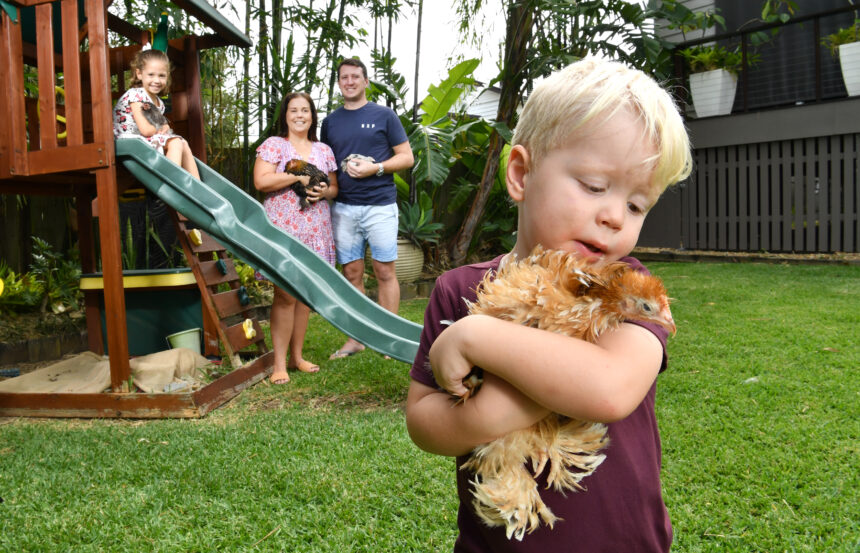
Six hens could be allowed on 400sqm blocks under proposed animal-law overhaul
UP to six hens could be allowed on 400sqm Redlands blocks under a proposed shake-up of council animal laws — a move that has sparked a council split over noise, odour and neighbour impacts.
Redland City Council voted 9-1 to begin 28 days of community consultation on changes covering backyard chickens, miniature goats, honeybees and dog access areas.
Capalaba councillor Jason Colley was the sole vote against the consultation motion, warning the proposal could open the door for thousands of smaller suburban blocks to keep up to six chickens.

Cr Colley stressed he supported public consultation but said residents should be presented with what council believed was the best outcome.
He said reducing the minimum lot size for chickens from 500sqm to 400sqm would affect many newer residential estates across the city.
“Local laws are established for the greater good, for the good of our community, not for an individual household,” Cr Colley said.
“I do not believe we should be signalling to the community that the place for keeping chickens is on 400 square metre blocks.”
Cr Colley said residents had raised concerns about noise, odour and vermin, particularly as homes were built closer together.
He said six chickens was carried over from the current rule for 500sqm lots and questioned whether the maximum should be lowered if council proceeded with the smaller-block proposal.
The draft changes specify hens only — not roosters — and retain requirements for owners to manage noise, odour and animal welfare.
Cr Shane Rendalls, who moved the motion, said the review was about giving families choice while balancing the needs of neighbours and animals.
“This is not mandating people to be able to have goats, bees, chickens [or] take their dog for a walk,” he said.
“But for those families that wish to do so … it gives the opportunity for that.”
The proposed changes would also allow up to two miniature goats on eligible larger lots, introduce provisions for European honeybees and update dog-access rules.
Council officer Graham Simpson, Group Manager Environment and Regulation, said the rules for honeybees were based on Queensland Beekeepers’ Association guidance and did not apply to native bees.
The draft proposes one hive on lots larger than 600sqm, with higher allowances on larger properties.
Mr Simpson said the chicken provisions followed an increase in people keeping animals at home during COVID-19, but stressed the consultation was the opportunity for residents to argue for different limits.
“It’s up to the council and the community to make decisions around that,” he said.
The dog-access component includes a proposal to make the existing dog beach at the end of Bay Street, Redland Bay, an off-leash area rather than an on-leash beach.
Dogs could also be allowed on lead at Laurie Burns Recreation Reserve on Coochiemudlo Island, where they are currently prohibited.
Council will separately investigate and consult the community and State Government about possible new off-leash areas at Nicholson Street, Russell Island, and beach and adjoining public open-space areas on Karragarra and Macleay islands.
Cr Paul Bishop urged residents to closely examine the draft, including the proposed number of chickens and beehives permitted on different lot sizes.
“Now is a time for residents to lean forward and give us your feedback,” he said.
Cr Paul Gollé asked whether prospective chicken owners would be made aware of their biosecurity responsibilities, including during any disease outbreak.
Mr Simpson said backyard chicken keeping would generally be self-assessed under the local law, with owners subject to their general biosecurity obligations.
The review would also remove duplicate references to dangerous dog breeds and lead requirements already covered under State legislation, with no practical change to council’s enforcement powers.
Cr Rendalls said community feedback would be crucial before council made a final decision.
“This is not a change in the regulations,” he said.
“This is a process of going out for consultation.”
Residents will have 28 days to make formal submissions once the consultation opens.