
Brisbane: The Next Big Moves — Major projects, connectivity, investment and jobs
Date: Thursday, 12 November 2026
Venue: Brisbane Airport Conference Centre, Brisbane
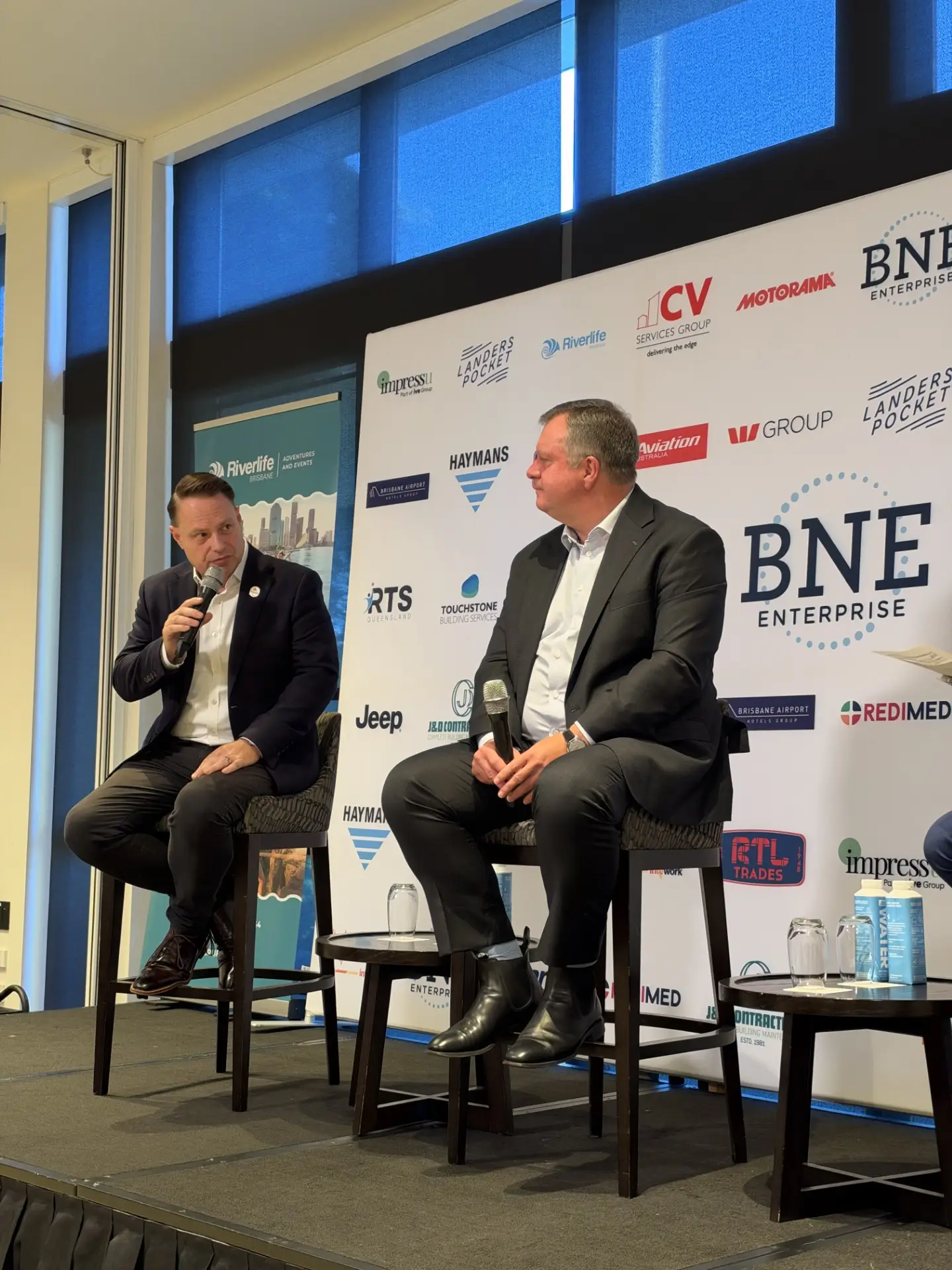
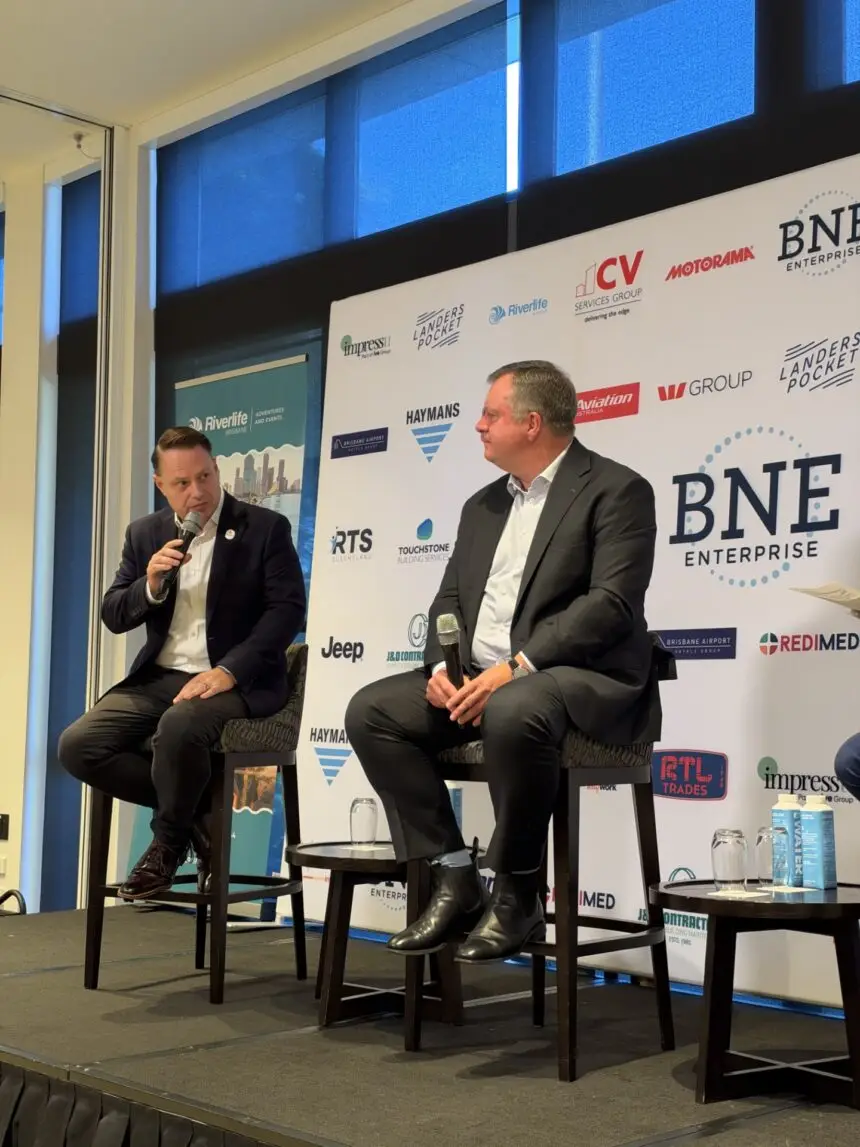
Panellists: Adrian Schrinner, Lord Mayor of Brisbane; Gert-Jan de Graaff, CEO, Brisbane Airport
Opening
Moderator:
Good morning, everyone. Thank you very much for the invitation to moderate this important discussion.
Before we begin, I would like to share a thought from the writer and urbanist Jane Jacobs: “Cities have the capability of providing something for everybody, only because, and only when, they are created by everybody.”

Those words feel particularly relevant to the people gathered here this morning. As Brisbane prepares to welcome the world for the 2032 Olympic and Paralympic Games, the investment, infrastructure and connections taking shape today will influence our city well beyond 2032.
The businesses represented here today — the people in this room — will have a very important part to play.
Lord Mayor and Gert-Jan, thank you for joining us. Let us begin by looking at Brisbane through the world’s eyes. You have both had opportunities to engage with international leaders, investors and representatives. What are they saying about Brisbane, what excites them about our city, and are you noticing a change in how Brisbane is seen internationally?
Brisbane on the world stage
Lord Mayor Adrian Schrinner:
Absolutely. Good morning, everyone.
As part of the Brisbane 2032 work a couple of years ago, we did research to establish a baseline for international awareness of Brisbane. The figures were quite alarming. But when you think about it, Australia has two globally known cities — Sydney and Melbourne — and beyond that, awareness drops away significantly.
Less than 10 per cent of the global markets surveyed knew much about Brisbane. That is already starting to change in the past couple of years, and the numbers are increasing. But the growth will continue exponentially.
When the Olympic and Paralympic Games are held in Los Angeles in 2028, Brisbane will take centre stage. There is a role for Brisbane 2032 in the closing ceremony, the flag is handed over, and things will really start to rise at that point.
It is predicted that awareness will rise from less than 10 per cent a couple of years ago to more than 40 per cent by 2028, and then to 80 or 90 per cent by the time 2032 rolls around. That is the growth trajectory.
What we are seeing is interest in Brisbane that we would not otherwise have seen. The best way to illustrate that is through the projects being planned and the investment decisions being made. Companies want to get into Brisbane, and they are not necessarily looking only at the traditional cost-benefit ratios for projects.
They are saying: “I need to be here in Brisbane. I need to be part of this.”
A local business or industry may look at a project feasibility study and say there is uncertainty — “Should I invest, or should I not?” But international investors are saying: “I do not care. I want to be in Brisbane. I am going to put my foot on the ground, plant a flag here and start investing, because we know the long-term prospects are incredibly strong.”
We are seeing that approach, and we have not seen it at that level before. That excites me. Global conditions may bring a certain level of uncertainty, and Brisbane has headwinds like other cities do, but we also have tailwinds that other cities do not.
Gert-Jan de Graaff:
I can only echo the Lord Mayor’s comments. I have recently returned from international trips, and there are still a lot of people who have no idea where Brisbane is, what the city can offer or what opportunities exist here.
You cannot go into a meeting in Brisbane without someone mentioning the Olympics, but most people around the world still do not know that we will be hosting the Games. That creates a huge opportunity. We have five-and-a-half years to make sure the world knows what Brisbane is, where it is and what it has to offer.
The people who do know about Brisbane are very excited. Every year, there is a conference called Routes — effectively speed dating for airports and airlines. Representatives from airports, airlines and tourism organisations from around the world attend. A few weeks ago, it was held in Frankfurt.
My team had 47 meetings with airlines, where we presented the business case for Brisbane. There was a great deal of interest in flying to Brisbane, starting new connections and growing existing services. That is a good example of people who know what Brisbane is about being attracted to do business here and to create global connectivity. That connectivity will be essential for the city to develop.
Moderator:
Gert-Jan, what are your family and friends in the Netherlands and other parts of Europe saying directly to you about Brisbane? Are they asking where to stay and what to do when they visit?
Gert-Jan de Graaff:
Obviously, my friends and family are not entirely objective, but they look at Facebook and Instagram, hear my stories and then come to Brisbane themselves. Literally, every one of them who has visited has said: “It is much better than I expected.”
That is a great way to describe Brisbane as a city, and it is certainly the opportunity we have. We need to develop those expectations and make sure people get what they are expecting. If we can make Brisbane even more attractive, then we have done our job.
Lord Mayor Adrian Schrinner:
It sounds a little like the old airline slogan: “Better than expected.” But it means we need to tell the story much better and much more broadly. We have five-and-a-half years to make sure people see those expectations, come here and want to return.
Projects, investment and the next pipeline
Moderator:
Let us talk about major projects and investment. Lord Mayor, there is an extraordinary amount of infrastructure investment planned across Brisbane and south-east Queensland. If we put 2032 aside for a moment, which two or three projects or investments underway now will make the biggest difference to Brisbane businesses over the next few years?
Lord Mayor Adrian Schrinner:
There has been a huge focus on what can be done before 2032, and what must happen before 2032. That is natural and to be expected.
The State Government has an Olympic delivery plan with the support of the Federal Government and, effectively, all three levels of government. It maps out what has to be done. But there is also a question of what can be done, or at least started, now.
If we see the journey as ending in 2032, we risk an Olympic hangover effect, where everything comes to a halt because no-one has put effort into planning the next pipeline of projects. Some projects may not be completed by 2032 because of construction timeframes or market capacity, but they need to be planned now and could potentially start before 2032.
The focus is shifting from the delivery plan to the next generation of projects. We are working with the State Government on that.
Brisbane Metro expansion is definitely part of that story. We do not want the endpoint for Brisbane Metro to be 2032. We want ongoing investment in expansion that continues for decades, because we know the region is growing and needs this kind of investment. Planning is underway now for what that may look like, and I am excited about it.
When people talk about infrastructure, they often think only of government projects. There is also a lot of other infrastructure being planned that is just as important. There is a strong push to build more hotels in Brisbane. That is permanent economic infrastructure our city needs.
There is private investment in other forms of infrastructure, including tourism infrastructure. It is encouraging because those assets go beyond government funding; there is a business case and a financial return associated with them.
There are exciting things happening in this part of the world. You will probably hear in the coming weeks about plans for Hamilton Northshore and what is proposed there. There is a lot of land that can be developed — not just for housing, although housing is critically important, but for other purposes as well.
It is right on Brisbane Airport’s doorstep. It will be one of Brisbane’s major growth precincts. Where else do you have that much developable land in such a good location? There is huge opportunity there. I cannot tell you exactly what is planned, because it is not my announcement to make. It is a State Government priority development area through EDQ, but there are very exciting things coming.
Moderator:
Gert-Jan, aside from airport development itself, what developments do you see creating the greatest impact for Brisbane?
Gert-Jan de Graaff:
Everything that improves connectivity on the ground to the airport is extremely important. The airport is a gateway to the world, but our air network only works if people can get to and from the airport on the ground.
Expanding road capacity is essential. We have been successful in developing a route network in the air, but we need the corresponding ground access. We are very supportive of the Lord Mayor and the various initiatives around public transport, Metro and the train network.
The Airtrain commercial arrangements, which run through to 2036, present a challenge for other public-transport solutions to the terminal buildings. We are in ongoing discussions with the State Government to make sure that changes. We want Metro to reach not only Skygate, but also Terminals 1 and 2, and ultimately a future Terminal 3.
Airport transformation
Moderator:
We are witnessing the most significant transformation of Brisbane Airport in decades. With the 2026 Master Plan approved and more than $5 billion in investment planned over the coming five years, what are the most important developments being delivered this year, and what should businesses and passengers expect to see?
Gert-Jan de Graaff:
There are quite a few members of my team here, and they know one of the sayings I use a lot: an airport is always ready, but never completed. That is really true. It is one big transformation that continues all the time.
I am probably most proud of the work we have done on the passenger experience in both the domestic and international terminals.
At the Domestic Terminal, we have developed a central security checkpoint with the most modern equipment. Passengers can leave their laptops, liquids and other items in their bags and move through the process much more quickly, without having to unpack and repack unless a bag needs further screening. It is an enormous improvement in the passenger experience and connects directly to the covered car park.
There is more to come at the Domestic Terminal, particularly around check-in and the forecourt, as well as further security improvements.
At the International Terminal, we completed a major transformation last year and are progressing well with moving security and border-control checkpoints from what was previously Level 3 to Level 4, which is the check-in level.
That means a passenger will complete the full process on Level 4: use the kiosks, drop a bag, pass through security and border control, then go downstairs into a completely new retail environment. It will be a fantastic experience for travellers.
It is still a work in progress, and there is a lot of work underway, but passengers will see more opening in the next few weeks. The full retail environment will take another year or so to complete.
Outside the terminal buildings, there are major developments underway as well. It is a continuous transformation.
Moderator:
Lord Mayor, this transformation of the airport is gathering full steam. How do you see it affecting our visitors as we move toward 2032?
Lord Mayor Adrian Schrinner:
Brisbane Airport is very well located and convenient to get to and from. Compared with other airports, there are still airports around the world without a rail connection at all. The Airtrain is a real strength.
The motorway network also connects directly into the airport, making it convenient to travel in all directions. It is a great way to enter Queensland.
But it is worth mentioning that the airport plays a critical role in the city’s industrial and commercial future. It is much more than an arrival and departure point for passengers.
Over about 30 years, there has been a change in the way industrial activity happens in Brisbane. Inner-city industrial precincts have progressively converted to residential and mixed-use areas. We can all think of examples. Newstead is a great one. It was an industrial place, with gasometers and coal once, and now it is one of Brisbane’s most desirable and thriving communities.
The same thing is happening in other inner-city precincts, including Kangaroo Point, West End and South Brisbane. So where does that industrial use go? The airport is one of the key receivers of that opportunity.
There are a huge number of jobs being created here that have nothing to do with aviation. That is a good thing because there is a quantum of land here that simply does not exist elsewhere. It is well located with strong motorway connections.
Without airport land and the capacity to grow jobs and industrial precincts here, those uses would be forced further and further away from Brisbane. That brings transport challenges and job challenges. People want to work relatively close to where they live, and Brisbane Airport provides that opportunity for many people. Without it, the city would suffer. It is a great thing for Brisbane.
Workforce, skills and the construction pipeline
Moderator:
With major infrastructure projects underway across Brisbane, significant commercial and industrial development at the airport, and continuing aviation growth, competition for skilled workers is becoming increasingly important. What are the biggest workforce challenges you are seeing, and what should government, industry and employers do now to attract, develop and retain the workforce needed to support this growth?
Lord Mayor Adrian Schrinner:
This is a huge issue. Many people in the room may be aware of the work Brisbane Economic Development Agency has done to map the construction pipeline going forward.
The report released in recent months contains an incredible amount of information about the projects in the pipeline, but it also maps the workforce needed to deliver them. It covers both government and private investment. Every project above $50 million is included.
Across Queensland, there is $173 billion worth of major projects coming between now and 2032. That is huge — incredible — and a big chunk of it will need to be delivered by skilled workers at a time when we have shortages.
People can spend a lot of time scratching their heads about how to solve this problem, but there are practical things that can be done. Two key shortages are concreters and tilers. We need to grow as many of those workers locally as we can, and good work is happening, but realistically we will not be able to fill the gap entirely through the local workforce.
We will need to attract workers from interstate — and people are seeing the opportunity to come to Brisbane — as well as bring skilled workers in internationally.
International workforce programs already operate in agriculture and manufacturing. They are a big part of how food gets onto our tables. But construction has been excluded from those arrangements, which is quite remarkable. That needs to change. Otherwise, either we will not be able to get everything done that we need to, or the cost of doing it will be prohibitively high.
Gert-Jan de Graaff:
We are not immune from the challenges the Lord Mayor has mentioned. We are also concerned about competition in the construction market and whether there will be capacity to deliver the work.
Of the $173 billion in major projects referred to by the Lord Mayor, Brisbane Airport’s planned investment of more than $5 billion represents about 3 per cent. Those investments need to be designed and built.
I do not think it is my role to comment on specific policies around immigration, but it is obvious that a labour force is required to deliver the plans coming forward.
Our focus is on how we can make it easier to work with us and position the airport as a place where companies and workers want to be. We are engaging construction partners differently from the past.
We have a very large landholding, and it will continue to grow. Remember, the airport is never completed. We will need capacity beyond 2032 as well. Providing that longer view gives industry more certainty and less risk going forward. Partnering is the name of the game. We want to work with firms that can help us deliver the plans to 2032 and, equally importantly, beyond it.
Lord Mayor Adrian Schrinner:
Gert-Jan does not want to comment on federal policy, but I will.
The immigration debate is becoming counterproductive. People understand that housing and infrastructure are under pressure, but the debate often becomes about people moving here permanently.
There are programs under which people can work here for a certain period and then return home. It works for them and it works for us. We already see that in many industries. This is not necessarily about permanently growing Australia’s population. It is about providing an opportunity for people to come in, help us with the projects we have, earn money and send it home.
It works for them, enriches their countries and communities, and helps relieve pressure created by a permanent increase in population. It can be done in a balanced way. As I said, it already happens in certain industries.
If you look at a construction site in Brisbane today and took away all the Kiwis, there would be no-one left. That is happening now. There is effectively no visa requirement between Australia and New Zealand, so workers can come and go, earn money here and return home. There is an opportunity to extend that model to some other countries as well.
Gert-Jan de Graaff:
We have talked a lot about construction, but that will not be our only concern. The airport will be running too.
We are forecasting a 100 per cent increase in passenger volumes over the next 20 years. We have about 25 million passengers today; in 20 years, we expect about 50 million passengers travelling to and from Brisbane Airport.
Today, we see about 80,000 people a day at Brisbane Airport — about 60,000 domestic and 20,000 international. That will double, double, double in different parts of the operation.
There are currently about 25,000 people working day in and day out across this precinct. There are even more people working for companies that provide services to the airport or to businesses operating here. That workforce will need to double in size as well, if not more.
We need to make sure we can attract that future workforce and create opportunities for those people. Otherwise, we will not deliver all the growth plans ahead of us.
Moderator:
Staying with workforce for a moment, there is a shortage of air-traffic controllers around the country, which may have a significant impact on Brisbane. Lord Mayor, you aimed to be a pilot when you were 16 and had your first solo flight. At the end of your career as Lord Mayor, might you consider becoming an air-traffic controller and working with Gert-Jan? That would be a good partnership.
Lord Mayor Adrian Schrinner:
I can start tomorrow.
Gert-Jan de Graaff:
I say this often to my colleagues. I sit on the board of Airports Council International, the global association of airports, and a lot of people there are challenged by their relationships with local government or regulators.
I always say that my Lord Mayor is an aviation enthusiast. The airport is his happy place. It is really true. We are very fortunate to have a Lord Mayor who genuinely wants to be here, and those relationships between the city and the airport are extremely valuable.
Technology, innovation and productivity
Moderator:
Let us move to technology, innovation and the very hot topic of productivity. Council is exploring AI-assisted traffic management, while Brisbane Airport is introducing greater automation into passenger processing and airport operations. Where do you see technology and innovation making the biggest practical differences to productivity, connectivity and operational efficiency over the next few years?
Lord Mayor Adrian Schrinner:
Australia clearly has a productivity problem. There is no doubt about it. AI and technology can be part of the solution, although they are not the only solution. It will take a multi-pronged approach to lift productivity.
With technology, we need to find the right balance. Sometimes you can go all-in on technology and think you can do a job with half the number of people, only to discover a few years later that you did actually need those people.
At Council, we are focused on using technology to divert people from back-office roles to frontline roles where they are needed. It is not fundamentally about reducing the workforce; it is about putting more people where they can make a practical difference.
We have a pilot underway that will begin early next year for AI-controlled traffic signals. It will be the largest of its kind in Australia. There have been a couple of smaller tests, but we are excited about the ability to optimise traffic flow and adapt in real time to conditions.
Unexpected events can send the road network into chaos. This technology can adapt in real time. At the moment, staff need to look at cameras, see what is happening and manually make adjustments. We have more than 900 sets of traffic lights across Brisbane, so there is a limit to what an individual operator can do.
This technology could be transformative. It can also help prioritise public transport. We do not see it as a way to reduce the workforce; we see it as a way to direct resources where they are most needed.
Gert-Jan de Graaff:
Technology and automation will change our operations significantly. Airports are very labour-intensive environments, and that will not change, but we can make processes more efficient, more effective and improve people’s jobs.
Airports are very data-rich and operationally complex ecosystems. When an aircraft arrives at a gate, bags are unloaded, passengers disembark, the aircraft is refuelled, catering arrives, it is cleaned and loaded again. All of that happens at the same time. It is like a Formula One pit stop.
For a domestic service, the turnaround can happen in about 30 minutes. For an international service, it may take an hour-and-a-half to two hours. Different companies provide all those services for the airline, so it is a complex process that must be coordinated.
AI enables us to coordinate it, provide real-time information to everyone involved and make sure they are in the right place at the right time and know what to do. That is a major advantage that did not previously exist.
We also have hundreds of vehicles driving airside every day. We have installed AI-enabled cameras in those vehicles to continuously monitor the condition of the road network, road markings, street signs and landscaping. Where maintenance is required, that is automatically loaded into the system for our facilities management teams. They know exactly where maintenance is needed, can prepare the work and keep everything operational and looking good.
These are opportunities to do things more effectively and efficiently while creating better jobs.
Lord Mayor Adrian Schrinner:
That brings to mind something Councillor Murphy has been doing with some of our garbage trucks. Cameras can identify potholes, signs needing replacement and other maintenance issues.
Rather than sending a team out with clipboards, we can collect that information automatically. A garbage truck travels down every street every week. As with Brisbane Airport, it is a great opportunity to make things more efficient.
How business can participate
Moderator:
One of the great opportunities for BNE Enterprise members is the scale of infrastructure and development happening across Brisbane and the airport precinct. For small and medium-sized businesses, it is not always easy to understand where to start.
What practical advice would you give businesses in the room looking to participate in upcoming projects, supply chains and investment opportunities?
Lord Mayor Adrian Schrinner:
There are a few different pathways and opportunity portals that businesses can use.
For a business wanting a piece of the action in the lead-up to 2032, there is the work of the Brisbane 2032 Organising Committee. Several billion dollars worth of contracting will be done through that committee. It is specifically about making the Games happen, rather than building infrastructure: kilometres of temporary fencing, security services, temporary seating and venue investment.
There are great opportunities there. Brisbane 2032 already has a portal for companies that want to register their interest and find out about those opportunities.
Then there is the Brisbane 2032 infrastructure pipeline as part of the State Government’s delivery plan. The Government will undertake its own contracting, with huge opportunities both for lead contractors and subcontractors. Depending on the type of business, you may seek to work directly with government or through a consortium or partnership.
There are also projects that are Olympic-adjacent but not specifically Olympic projects, and there are many of those opportunities as well.
My advice is that Brisbane and Queensland will be making a first impression on many people around the world, and we only get one chance to make a first impression. There will be strong procurement requirements and a close focus on a business’s track record.
If you are a start-up with no track record, it may be difficult to secure a major contract because there is risk associated with that. That is understandable. Demonstrating a record of delivery will be critical. We need to know you can deliver.
I am not saying there are no opportunities for start-ups, but procurement is also a risk-management exercise. Partnership opportunities exist for those businesses.
We will be looking for demonstrated track record and local benefits. That is where local business can really shine. What is the flow-on effect for the local economy, local workers and local people if you get the contract rather than an international company?
There will be a strong Queensland-first focus. That is a good thing because it helps us build capacity. There are great examples from other Olympic Games where local business has been supported and taken to the next level. It happened in Sydney and recently in Paris.
We want to see that happen, but we also have to manage risk. Things need to be done on time. We cannot have companies failing while delivering major Olympic projects. That is the balance we need to find.
Moderator:
Gert-Jan, would that be similar at the airport — finding the right partners for Brisbane Airport?
Gert-Jan de Graaff:
It always is. I would recommend that everyone in this room who wants to do business with us makes sure we know you exist. Approach my team members and make sure they know what you can offer, what solutions you have and what problems you might be able to solve for us.
Yes, we are talking today about big projects — terminals, cargo buildings and those sorts of things — but there is also a lot of work happening across the airport. You can all be involved.
Brisbane Airport Corporation has more than 600 businesses with facilities, buildings and activities at the airport. You may be well equipped and well positioned to provide services to those other companies as well.
That is why being here, being part of BNE Enterprise and engaging with those companies is as important as engaging with my team. There is a lot of opportunity. I often hear companies say they have difficulty finding local businesses and service providers; I do not hear them say there are too many. There is plenty of work to go around.
Closing
Moderator:
Ladies and gentlemen, we have covered a range of topics this morning, and I hope you have gained new insights into how you are involved, want to be involved and might be involved.
I would like to close with a quote from the late American author and activist Helen Keller: “Alone we can do so little; together we can do so much.”
That is a fitting reminder that Brisbane’s next chapter will be shaped by what we achieve together. Council, Brisbane Airport and the businesses represented here today all have a part to play.
By strengthening our relationships and working together, we can turn today’s ideas into lasting opportunities for people and communities. Brisbane’s next big moves will be measured in the opportunities they open up for people. Long after the final medal is awarded, those opportunities should still be opening doors.
Lord Mayor and Gert-Jan, thank you for sharing your perspectives this morning. Ladies and gentlemen, please join me in thanking our panellists.