
COOCHIEMUDLO Island fishing writer Michael des David believes catching fish is less about expensive accessories and more about preparation, stealth and decisive technique.
The 67-year-old said anglers needed to be ready to strike rather than merely react when a fish showed interest in their bait.
“Catching a fish is an action, not a reaction. You need to be ready and act to set that hook,” Mr des David said.
“Fish will swim around a bait, pick it up and drop it a few times before they decide to go for it. That’s the tap, tap, tap.

“Then the fisherman should set the hook quickly. It is a purposeful decision and 90 per cent of fishermen will get the fish that way.”
Mr des David said a sharp hook was central to success.
“I use chemically sharpened hooks and then I will use a whetstone to reduce its thickness, making it easier to penetrate,” he said.
He also urged fishers not to overcomplicate their set-up, arguing that swivels, sinkers and coloured line could make wary fish less likely to take a bait.
“You don’t need a swivel or a sinker. If the fish see the bait spinning around or on the floor, they won’t touch it,” he said.
“The fish are hanging around the jetties or rocks and like bait floating on the current.”
Mr des David uses a two-metre rod, a 4500 reel and 8kg nylon fishing line.
His love of fishing began in South Africa, where his father took him to rock pools, rivers and the ocean from the time he could walk.
After moving first to New Zealand and then to Cleveland at the age of 40, Mr des David said he had to learn the local conditions through trial and error.
“Once you’ve cracked the code, it’s about technique and process,” he said.
“Catching a fish isn’t just about throwing a line in.”
Mr des David previously delivered bait on Coochiemudlo beaches and offered fishing lessons, taking newcomers out in favourable conditions to help them land their first fish.
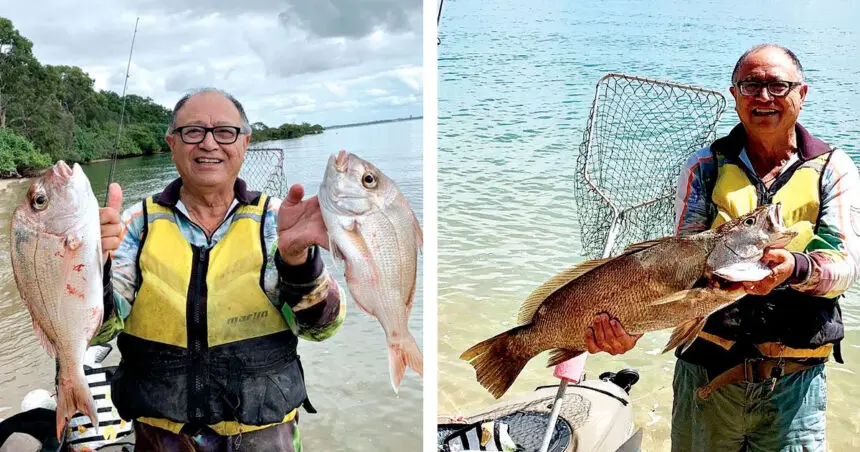
These days, he prefers fishing from a 1.5-metre kayak in three to four metres of water around Coochiemudlo, regularly catching snapper, sweet lip and mulloway.
“Tinnies make a noise and it scares the better fish off,” he said.
“The kayak is very stable and can sit over the top of the bigger fish. Once you set the fish, the fish will pull you towards them, even an average-sized fish.”
Sharks, however, have become an increasing challenge.
He recalled one unnerving encounter about 15 years ago while chasing tuna several kilometres off Cleveland.
“A shark rammed the kayak and I was drenched,” he said.
Fishing tips from Mr des David can be found on the The Coochiemudlo Squire Facebook page.