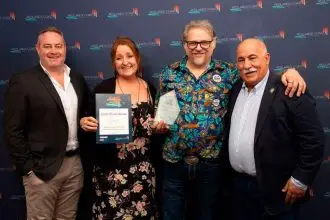


AS the region looks towards the upcoming Olympic and Paralympic Games, local tourism operators recently gathered at a packed regional tourism forum featuring an outstanding lineup of speakers.
The event brought together tourism operators, council representatives, State Government representatives, and key industry stakeholders to explore the future of the visitor economy.
Throughout the program, Olympians, officials, and industry experts shared insights across a broad range of tourism topics, while SCALA The Training Company Managing Director Steve Wiggers focused specifically on the growing role of artificial intelligence in modern business.
As AI continues to reshape the way we live and work, businesses across the Redlands are facing both exciting opportunities and genuine challenges.

During his presentation, Mr Wiggers explored how AI is already transforming tourism and everyday business operations as the region prepares for the opportunities the Games will bring.
His presentation highlighted a clear tension.
Many business owners are excited about AI’s ability to save time, improve efficiency, and unlock new opportunities.
At the same time, there are concerns that overreliance on technology could reduce critical skills, spread misinformation, or damage the reputations businesses have worked hard to build.
For tourism and hospitality operators, where genuine human connection and memorable experiences are at the heart of the product, these concerns are particularly significant.
Mr Wiggers described AI as a valuable business consultant capable of handling routine tasks such as drafting emails, managing bookings, creating itineraries, and organising daily priorities.
By automating repetitive work, business owners can reclaim valuable hours each week and redirect that time towards serving guests, growing their businesses, and spending more time with family.
However, he also warned that AI presents new challenges.
Increasingly, travellers are planning holidays within AI platforms rather than searching individual business websites.
This shift means that traditional search engine optimisation alone may no longer be enough to capture visitor attention.
In some instances, AI has generated inaccurate or outdated information, directing visitors to businesses that have closed, recommending incorrect trading hours, or promoting services that no longer exist.
These mistakes can quickly lead to disappointed visitors, poor online reviews, and lost revenue for local operators.
Beyond these practical issues, Mr Wiggers also discussed the broader workplace impacts of AI.
He noted that many employees are already using AI tools without their managers’ knowledge, reflecting both growing adoption and ongoing uncertainty about how the technology should be used responsibly.
His key message was that AI literacy is becoming an essential business skill.
Understanding how AI works, recognising its limitations, and verifying the information it produces will be increasingly important for every organisation.
Rather than viewing AI as something to fear, Mr Wiggers encouraged businesses to adopt a practical and balanced approach.
He recommended identifying repetitive and predictable tasks that can be safely automated, allowing owners and staff to focus on the parts of their work that technology cannot replace, including welcoming guests, creating authentic experiences, solving problems, and building genuine relationships.
He also introduced the concept of AI Enhanced Optimisation, or AEO, as a complement to traditional search engine optimisation.
As more travellers rely on AI to discover destinations and plan their journeys, businesses will need to adapt their online presence to ensure accurate and relevant information is available across digital platforms.
Simple actions can make a significant difference.
Regularly updating business listings, confirming opening hours and event information, and ensuring online content reflects the authentic voice and personality of the business will help improve both customer experience and AI-generated recommendations.
Artificial intelligence is not a destination but a powerful collection of tools.
For Redlands tourism operators preparing for the Olympic and Paralympic Games, the opportunity lies in embracing automation while preserving the genuine human experiences that continue to make the region a memorable place to visit.