
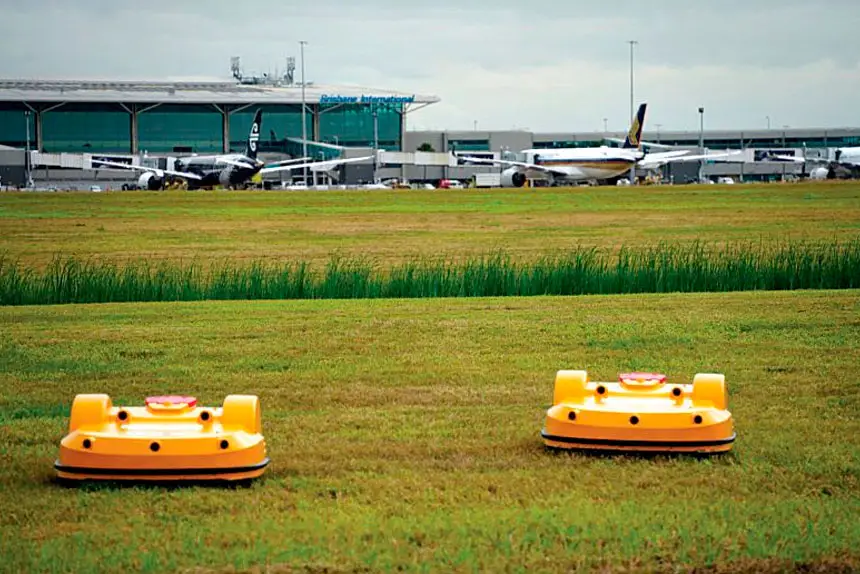
BRISBANE Airport has become the first major airport in Australia to deploy a fleet of autonomous robot mowers in a move expected to cut emissions, reduce operating costs and improve airfield maintenance.
The trial program is already managing a growing portion of the airport’s 919 hectares of airside land – an area equivalent to 54 South Bank Parklands – and marks a significant step forward in the airport’s push towards greater automation and sustainability.
The robotic fleet operates using advanced navigation and safety technology with sensors, geofencing and physical barriers ensuring the four mowers remain within designated safe zones.
Brisbane Airport says replacing traditional diesel-powered mowers with automated electric units will save more than 60,000 litres of diesel each year, creating a zero-emissions mowing operation powered by solar energy and the airport’s renewable-backed electricity network.

Additional airside areas are expected to be incorporated into the program as the fleet expands.
Brisbane Airport chief executive officer Gert-Jan de Graaff said the initiative demonstrated how innovation could deliver practical environmental and operational benefits.
“We’re always looking for smarter ways to operate, and these autonomous mowers help us improve efficiency while supporting our sustainability goals,” he said.
“These robot mowers might be small, but their impact is significant.
“Unlike conventional mowing, which must be scheduled around air traffic and staff availability, these robotic mowers can operate day and night.
“This reduces disruption to flights and the need for manual mowing, helping to maintain our airfield while keeping safety front and centre.
“And because the grass is being mowed continuously, it’s actually creating greener grass by selectivity encouraging better species and allowing us to reduce the use of herbicides.”
Brisbane Airport Head of Sustainability Jess Rudd said the technology aligned with the airport’s commitment to achieving and maintaining Net Zero emissions across its scope one and two operations.
“As one of Australia’s most forward-thinking airports, Brisbane Airport continues to invest in technologies that enhance operations, improve sustainability outcomes and support our journey toward a lower-carbon future,” Ms Rudd said.
“As a sustainability leader, we take our role in reducing our impact on the environment very seriously.
“By replacing conventional diesel-powered mowing operations with smart, automated technology, Brisbane Airport is helping to lower its environmental footprint while ensuring the safe and reliable maintenance of airside land.”
According to Brisbane Airport, the autonomous mowing system is expected to reduce vegetation management costs by an estimated 70 per cent while also removing the need for around 250 hours of sweeper truck operations.
The innovation has already attracted industry recognition, winning the Australian Airports Association Innovation Award.
Brisbane Airport Innovation Lead Oscar Maan said the project reflected the airport’s broader commitment to trialling new technologies that deliver measurable outcomes.