
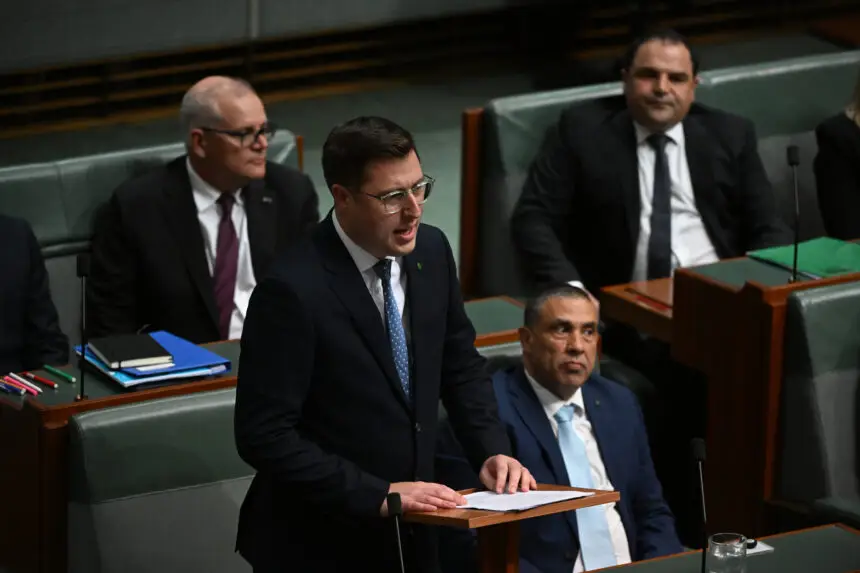
New data from the AMPLIFY House Monitor reveals a sharp contrast in how the two federal MPs covering Redlands and Bayside electorates are using their time in Parliament, with the Member for Bowman spending a significantly greater share of time on policy debate than the Member for Bonner.
The analysis, which uses artificial intelligence to categorise parliamentary speeches, comes amid growing public frustration with politics, with 71 per cent of Australians believing the long-standing promise of a “fair go” and rising living standards has been broken.
According to the data, Henry Pike MP (LNP) devoted 43.8 per cent of his speaking time in the House of Representatives and Senate to policy matters — well above the parliamentary average identified by AMPLIFY in the first six months of the term.
By comparison, Kara Cook MP (ALP) spent 31.6 per cent of her speaking time on policy, with a larger proportion directed to political theatre.

Different parliamentary styles
The breakdown shows Mr Pike spent just over one-fifth of his time (21.1 per cent) on political theatre, such as partisan attacks and credit-claiming, while almost a third (31.5 per cent) was dedicated to recognition, including tributes and community acknowledgements.
Bad behaviour and formalities accounted for a combined 3.6 per cent of his contributions.
Ms Cook’s profile was markedly different.
Political theatre made up the largest share of her speaking time at 37.5 per cent, while recognition activities accounted for 29.7 per cent.
Her time spent on policy was lower than her Bowman counterpart, though she recorded very low levels of bad behaviour (0.6 per cent) and formalities (0.7 per cent).
Context of national concern
The comparison sits within broader findings from the AMPLIFY House Monitor, which found that in the first six months of the current parliamentary term, less than 40 per cent of total speaking time across both chambers was spent debating policy issues affecting communities, such as housing affordability and the rising cost of living.
AMPLIFY’s analysis is based on more than 16,000 speech segments and 625 hours of debate from the 48th Parliament, using Hansard transcripts prepared by OpenAustralia.
Importantly, the rankings are based not on how often an MP speaks, but on how they use the time they are given, allowing for comparisons between members with very different roles and speaking opportunities.
Local implications
For voters in Bowman and Bonner, the data highlights contrasting approaches to parliamentary engagement: one more heavily weighted toward policy discussion, the other more focused on political contest and advocacy.
As AMPLIFY notes, the project is not intended to label any individual’s performance as good or bad, but to improve transparency.
“The goal is to give Australians insight into how their representatives engage with each other and the issues that matter,” the organisation said, inviting public feedback to refine and strengthen the model.
In electorates grappling with housing pressure, cost-of-living stress and infrastructure needs, the figures are likely to add fuel to ongoing debates about whether Parliament — and individual MPs — are focused on what voters care about most.