



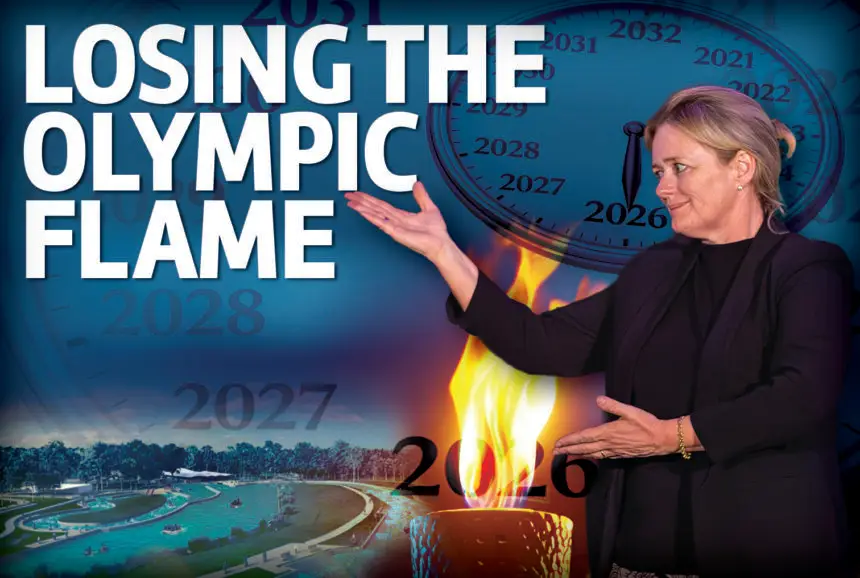
MAYOR Jos Mitchell has conceded Redland City Council is “behind the ball” on preparations for the Brisbane 2032 Olympic and Paralympic Games.
The admission raises fresh fears Redlands could miss out on long-term legacy wins as rival southeast Queensland councils race ahead with detailed Olympic planning.
Her comments come as renewed scrutiny falls on the Redlands Coast 2032 Legacy Working Group, set up in early 2022 to help maximise the city’s Olympic moment — but now under fire for a lack of visible progress.
The 11-member volunteer panel — drawn from sustainability, tourism, transport and sport — was launched amid bold promises to empower the community and shape a once-in-a-generation Olympic legacy.

But despite the early fanfare, the group held just two formal meetings and a single workshop — in May, June and August 2023 — under the previous council.
It did not meet again until November 24, 2025 — and only after Local Redland Bayside News exposed the lack of activity — fuelling growing concern about whether the city is anywhere near ready to lock in a lasting Olympic legacy.
Addressing councillors, Mayor Mitchell laid out the group’s stop-start history, pointing to repeated failures to reach quorum, pauses while awaiting state venue decisions, and further delays after the State Government released its own Olympic legacy framework.
“Personally, I feel we are running a little behind the ball on this, particularly having visited other local government areas and seen how they have progressed their preparations,” Mayor Mitchell said.
“I’ve had the opportunity to visit the Sunshine Coast and speak with the Sunshine Coast Mayor about the work they have done.
“The level of planning they undertook prior to their application to be a venue host, and their clarity about what they wanted to achieve from the Olympic Games, is inspiring.”
Council’s General Manager of Infrastructure and Operations, Chris Isles, was blunt in his assessment, warning councillors of the structural limitations now holding Redlands back.
“For clarity, last year a proposal was brought forward to allocate an officer specifically to Olympic-related work. That proposal was not supported by Council,” Mr Isles said.
“So, as an organisation, we have been trying to progress Olympic preparedness, but without dedicated resourcing, that work has limits.”
He contrasted Redlands’ position with neighbouring councils, noting the Sunshine Coast has three full-time staff dedicated to Olympic preparations, while the Gold Coast and Brisbane City councils have even larger teams focused solely on Games planning.
“At Redland City Council, we currently have no one whose sole role is to do this work,” he said.
“Instead, we have many people contributing in addition to their core responsibilities.
“It is becoming increasingly critical that we are able to dedicate time and people to this work — particularly around public legacy — to ensure the city is genuinely ready to be a host city.”
While he acknowledged operational planning was moving ahead through state-level working groups — covering waste, workforce and procurement — Mr Isles stressed Redlands’ Olympic legacy would hinge less on new infrastructure and more on how effectively the city leverages private sector investment and tourism opportunities.
Councillor Peter Mitchell urged swift action, calling for a clear timetable and proper resourcing to finally get Olympic legacy planning moving.
“What I would like to understand is this: how quickly can we resource this properly?” he said.
“Whatever is required — officers, support, or other resources — over the next, I would suggest, three months, to finalise a legacy working plan so we are absolutely clear on our priorities.”
Cr Mitchell warned the council could not afford to lose another year to talk, cautioning that further delays would only deepen the city’s Olympic legacy gap.
“We want to be acting — or continuing to act — and sharpening and focusing that action,” he said.
Councillor Shane Rendalls said that while advocacy and operational readiness were ticking along, council had “largely failed” to take the community with it on the Olympic journey.
“When you look at other councils — Sunshine Coast, Brisbane, Gold Coast, Logan — they have been very active,” Cr Rendalls said.
“Their mayors and councillors have been out in the community, encouraging, celebrating, and building excitement about what the Olympics will bring.”
He pointed to the Sydney 2000 Olympic Games as the benchmark, where volunteerism and civic pride emerged as one of the most enduring legacies.
“That spirit of volunteerism was a defining feature of Sydney 2000, and we still see its legacy today,” he said.
Councillor Jason Colley agreed Redlands was trailing rival councils, saying the responsibility now sat squarely with elected members to pull the city back on track.
“I participated in an LGAQ webinar late last year with other local governments, and it was quite clear that we are a little behind where some other councils are in terms of legacy planning,” Cr Colley said.
“That is now on us as a Council to address.”
He said any further investment would likely create short-term budget pressure, but warned it was a necessary price to pay if Redlands was to secure meaningful long-term Olympic benefits.
“If that is what is required to ensure we deliver the best possible legacy outcomes for our community, then that is what we need to do,” he said.
Mayor Mitchell said the legacy working group had now been reactivated, with meetings set to run more frequently — including the next session scheduled for January 30.
“With the relatively short timeframe we now have, we need a very focused and targeted approach to determine what is possible, what we can realistically secure, and what will deliver the greatest benefit to our community,” she said.