




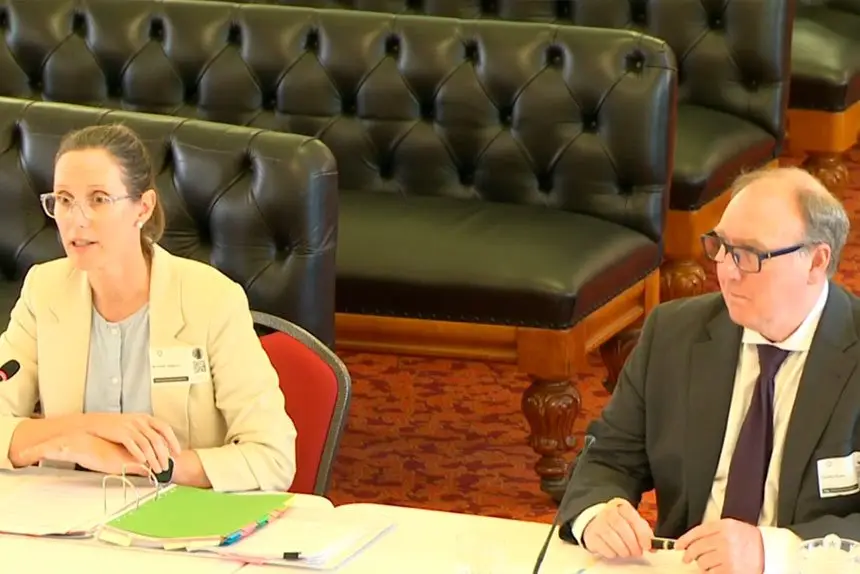
Independent Assessor Bronwyn Blagoev has told a parliamentary committee that complaints against Queensland councillors surged last financial year, with Redland City Council among the hotspots.
Ms Blagoev said her office, the Office of the Independent Assessor (OIA), received more than 1000 complaints — a 15 per cent increase on the previous year — as newly elected councillors adjusted to their roles.
Despite the rise, she said the OIA had met all complaint-handling targets and was focused on serious misconduct, with the vast majority of complaints dismissed or resolved without further action.
Below is the transcript of Ms Blagoev’s opening statement to the committee.

Transcript – Independent Assessor Bronwyn Blagoev
Committee Hearing
Bronwyn Blagoev:
Good morning, Chair, members of the committee.
I’d like to thank the committee for the opportunity to present today.
As the Chair said, I’m Bronwyn Blagoev, Independent Assessor, and with me today is Charlie Kohn, Deputy Independent Assessor.
I thought I’d start by providing the committee with a general update on OIA outcomes since our last hearing back in February.
We’ve recently collated the data for the end of the financial year, which showed that last financial year we received 1,008 complaints in total.
This represents a 15 per cent increase on the previous financial year.
While we can’t pinpoint a specific reason for that increase, we do note that it’s the first full year after the local government elections.
This is typically the period when new councillors are finding their feet, trying to understand their obligations under the local government legislation and the code of conduct, and just generally settling into their role.
This rise in complaints actually mirrors the increase we saw following the last council elections as well.
So there is typically a pattern that emerges post–council election.
Despite the increase, I’m pleased to report that the OIA has maintained its performance standards and met all complaint-handling timeframe targets.
During the financial year, we introduced new target timeframes for ourselves, supported by third-party pauses, so we were only measuring our own efficiency.
Our average time for assessing a complaint last financial year was 2.54 working days, and we know that is particularly important to councillors.
I’d like to take the opportunity to thank our hardworking assessment team, who assessed all of those complaints last financial year.
The OIA’s focus remains on serious misconduct.
Last financial year, 81 per cent of all complaints assessed were dismissed or had no further action taken by the OIA.
This is up from 76 per cent the previous year.
That outcome demonstrates that our approach is to prioritise more serious matters, and we allocate our resources accordingly.
During the last financial year, one in 10 complaints assessed were progressed through to a misconduct investigation.
All up, we did 102 investigations last financial year.
Also, last financial year we progressed 11 misconduct matters from the investigation stage through to the natural justice/legal stage.
Out of those, we only made four applications to the Councillor Conduct Tribunal.
Following the 2023 legislative reforms, the OIA was given the power to issue statutory recommendations to councillors instead of pursuing more punitive and time-consuming measures.
This mechanism has proven highly effective, with the OIA issuing 69 recommendations for training and intervention during the financial year.
By addressing conduct issues through a recommendation, we’ve been able to reduce the financial and administrative burden on councils whilst delivering better outcomes.
Encouragingly, we see councillors respond positively and remediate their conduct.
Eighty per cent of councillors who received a recommendation only received the one recommendation, showing there was limited recurrence of conduct.
We’ve taken into account a range of public interest factors when we decide what action to take with matters such as conduct-breach matters, which I know have been a little bit controversial.
We follow an escalation process.
We’ll typically dismiss the lower-level complaints.
At times we’ll give some sort of warning, we’ll speak to councillors, we’ll give them additional information, we’ll recommend training.
But if the conduct continues, even at a relatively low level, we’ll then move up to what we call a recommendation.
When we receive further complaints and conduct-breach issues persist, and we see councillors receiving multiple recommendations, that is when we would typically escalate the matter and refer it back to the council as a conduct-breach matter.
I think last financial year, 22 matters were referred to councils as conduct breaches.
Out of those, all but one councillor had received previous warnings.
The one councillor who had not received a warning was referred because the matter was just that serious.
The 22 matters involved seven councillors.
So it’s actually a very small number of councils, and a very small number of councillors, that are impacted by conduct breaches.
All up, 3 per cent of complaints resulted in a referral back to a local government last financial year.
We continue to work closely with our stakeholders.
Last year we saw the re-establishment of the Local Government Interagency Liaison Group, which has representatives from the Ombudsman, the CCC, the Audit Office, and the Department.
That group has been re-established.
We also maintain strong working relationships with the LGAQ and the LGMA.
At our last committee hearing, we talked a little bit about social media and some of the issues councillors were facing in that space.

Since then, we’ve partnered with the LGAQ and presented two webinars to councillors, dealing with all sorts of challenges they face on social media.
They’ve been a great success.
I commend the LGAQ for that and look forward to doing more work with them in that space.
Finally, I just wish to acknowledge and thank my staff for their ongoing dedication.
The timeframes we achieved this past financial year were extraordinary, particularly given the 15 per cent increase in complaints.
Chair, I’m happy to hand over and answer any questions you may have.