
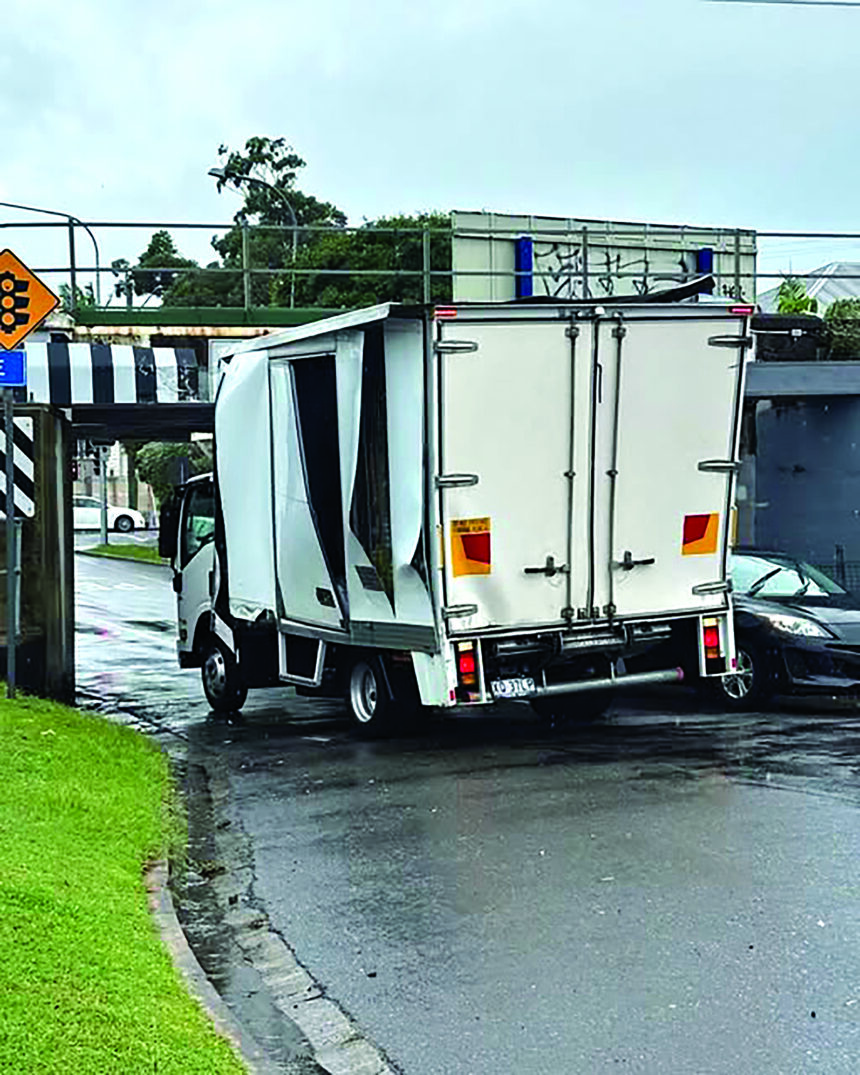
THE notorious Pine St railway bridge in Wynnum has again become the centre of controversy with political leaders calling for urgent action after another truck struck the structure.
In a letter to Brisbane Lord Mayor Adrian Schrinner, Lytton MP Joan Pease called for Brisbane City Council to review safety measures at the site following repeated crashes.
Ms Pease said the bridge had been struck twice in the past week alone by over-height vehicles, despite recent attempts to improve warnings for drivers.
“While the gantry on either side of the bridge prevents direct damage to the rail infrastructure, each strike still causes disruption, delays, and considerable frustration for road users and train commuters,” she said.

The state MP said recently installed road markings aimed at warning drivers appeared to be failing.
“Drivers continue to strike the bridge at an unacceptable increased frequency,” she said.
Ms Pease also raised concerns about the visibility of warning signs near the bridge.
“Northbound warning signage is partially obscured by tree cover, while southbound warnings are often obstructed by parked vehicles,” she said.
“These issues significantly reduce the effectiveness of the current deterrents.”
She urged Brisbane City Council to investigate additional engineering or traffic management solutions to prevent further crashes.
“One potential example is the well-known ‘Duck Duck’ bridge off Berrima Street, where physical deterrent measures metres from the bridge have proven highly effective in preventing over-height vehicles from striking the structure,” she said.
“This measure could be considered for Pine Street.”
Ms Pease said council engineers were best placed to determine the most appropriate solution but argued the frequency of incidents showed stronger action was needed.
“I would appreciate Council urgently reviewing the effectiveness of the current measures and investigating alternative deterrents that will finally address this ongoing issue,” she said.
The latest crash has reignited community frustration.
Many residents say the repeated incidents show current warning systems are not working.
Some suggested installing a physical height barrier or “sacrificial beam” further back from the bridge so over-height vehicles hit the barrier instead of the railway infrastructure.
Others called for flashing lights, sensors, or over-height detection systems like those used at other low bridges.
Several locals also raised concerns about the impact on rail services, with bridge strikes often leading to delays on the line while safety inspections are carried out.
However, Queensland Rail said the bridge itself was protected during the latest incident.
Queensland Rail Head of South East Queensland Neil Backer said the installed protection beam prevented damage to the rail infrastructure.
“Due to the presence of the protection beam, the bridge wasn’t damaged, and no rail services were disrupted,” he said.
Mr Backer said additional safety measures had recently been installed at the location as part of an ongoing trial.
“This incident follows the recent installation of new painted road markings approaching the rail bridge, adding to the existing protections including prominent warning signs, height signage, protection beams and strike-monitoring cameras.
“There’s no excuse for not knowing your vehicle’s height.”
Queensland Rail said its road-marking trial at the location has been underway since December 2025 in partnership with the Department of Transport and Main Roads and Brisbane City Council.
The rail operator also confirmed Pine Street Bridge is owned and maintained by Queensland Rail, including the warning chime operations at the site.
Data released by Queensland Rail shows the location continues to experience frequent incidents, with 25 protection beam strikes recorded at Pine St, Wynnum during 2025.
Local councillor for the Wynnum Manly Ward Alex Givney said the ongoing incidents were a serious concern for residents.
“The community is rightly concerned about the frequency of incidents at this location — and so am I,” Cr Givney said.
“It’s a busy thoroughfare for Bayside residents so any disruption can be incredibly frustrating.
“I’ve continued to meet with Queensland Rail to advocate on behalf of our community and they have confirmed they are investigating additional options.”
Despite the measures already in place, political pressure over the issue is growing.
Brisbane City Council Opposition Leader Cr Jared Cassidy said the situation highlighted what he described as a failure by the council administration to act.
“Adrian Schrinner and Cr Alex Givney need to actually do something,” he said.
“The Pine Street bridge fiasco is an example of how their absurd blame game impacts the everyday lives of local commuters.
“A simple investment into better road markings and street signs on this council road can save commuters time and money wasted on avoidable bridge strikes.”
Cr Cassidy also pointed to council finances, saying funds could be redirected to address the issue.
“Council reported a windfall of over $32 million in parking fines since July 1, 2025,” he said.
“We could put some of that into fixing this issue, but instead ratepayers are losing millions for monthly junk mail and overseas travel.
“Baysiders deserve better.”
Motorists face fines of $1,335 and four demerit points for damaging rail infrastructure.
If the matter goes to court, the maximum penalty for causing damage to rail infrastructure can reach $13,352.
Queensland Rail said it actively pursues drivers to recover costs associated with bridge strikes.