
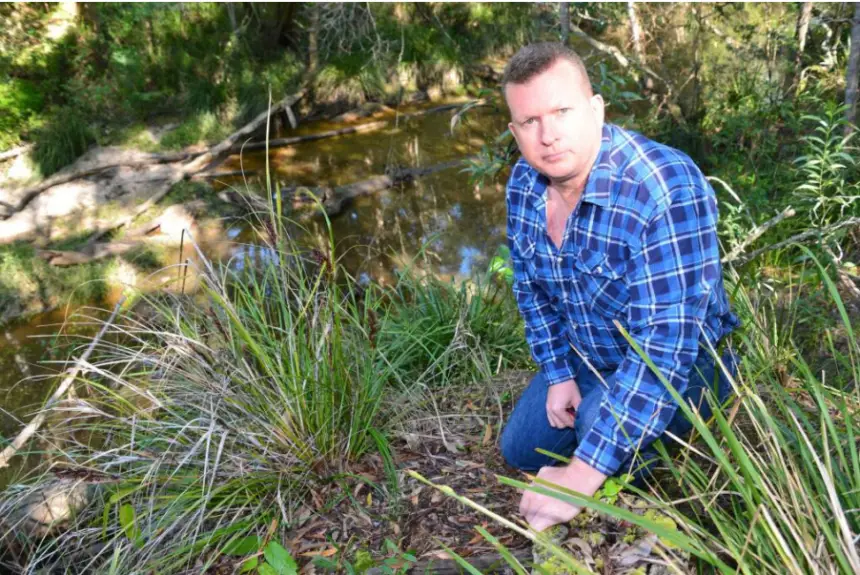
A local catchment group has accused Redland City Council of ignoring years of warnings and expert advice, claiming the construction of a concrete path along Luke Street has caused serious damage to mature trees and degraded koala habitat.
Eprapah Creek Catchment Landcare Association (ECCLA) convenor Lynn Roberts said concerns about environmental impacts dated back more than 15 years, long before the Luke Street path was built as part of access to a proposed bridge.
“Our group has had concerns about the damaging effects of possible pathway construction since the bridge was first mooted,” Ms Roberts said.
“The earliest reference I can find is a letter sent by ECCLA to the mayor and councillors in 2008, requesting input from our catchment group into the route of any future paths.”

Ms Roberts said ECCLA had repeatedly asked to be consulted, including during an address to council on February 21, 2018, but those requests were never meaningfully acted on.
She said the first physical indication of a potential path route emerged in 2016, when residents noticed flagging tape along the creek behind a newly constructed wetland in Marcoola Street.
“Local residents were very upset about the potential increase in vandalism behind their houses,” she said.
“The first route chosen was extremely destructive and would have meant the removal of many very old trees, which of course we argued strongly against.”
Public concern led to an on-site meeting in July 2017, organised by councillor Paul Golle, where the environmental impacts were raised.
Shortly afterwards, Cr Golle publicly expressed a desire for the project to be dropped.
By 2021, Ms Roberts said council documents showed the preferred path route was no longer near Luke Street, reinforcing the belief among ECCLA members that the more damaging option had been abandoned.
“At every ECCLA meeting since 2016, we discussed the issue and no attendees had been advised or observed any activity regarding the bridge,” she said.
“We assumed reason had prevailed.”
That assumption was shattered in July 2025, when Ms Roberts attended a Luke Street Bushcare working bee as the group’s convenor.
“I was shocked to see the amount of disturbance to the area near the creek and horrified to see the lack of anti-erosion measures,” she said.
“After researching the council website, I found the proposed route of the paths to the bridge.
“This was the first our group knew of the pathway along Luke Street.”
Ms Roberts wrote to the mayor and councillors outlining ECCLA’s concerns on July 28, 2025, but said the response she eventually received was deeply disappointing.
“It was upsetting that the main environmental issues weren’t addressed,” she said.
“Instead, our hard-working volunteer group was unfairly attacked on an entirely unrelated matter. I found that insulting.”
As an environmental scientist, Ms Roberts said she believed the long-term survival of the mature trees along Luke Street was now in serious doubt.
“I do not see how these trees can survive with over 90 per cent of their roots covered by impervious surfaces,” she said.
“On my last visit, there was no evidence of koala usage of these trees, whereas in the past scats were always obvious.”
She said the construction also appeared to breach Australian Standard AS4970:2025, which sets out tree protection zone requirements based on trunk diameter.
“For trees with a diameter of more than one metre, the tree protection zone would be over 12 metres,” she said.
“The 2.5-metre concrete path is within 30 centimetres of one very large tree, about 40 centimetres from another, and within the protection zones of at least another 10 trees.”
Ms Roberts said ECCLA had proposed an alternative route that would have significantly reduced environmental risk.
“We proposed widening the Marcoola Road path to 2.5 metres for a multi-purpose trail,” she said.
“This was the preferred route in the council’s December 15, 2021 meeting agenda, and no major trees would have been affected.”
With the path now complete, Ms Roberts said ECCLA was seeking acknowledgement from council that the decision had caused harm and needed to inform future practices.
“I would like council to acknowledge the poor outcome of their decision and the long-term effect it will have on these old-growth trees,” she said.
“Path construction near mature trees needs far more consideration of koala usage, local knowledge and environmental expertise.”
However, Division 3 Councillor Paul Golle has rejected claims that concerns about the Luke Street pedestrian path were ignored, saying the project was not council-delivered and long-standing planning decisions limited what could be changed once construction began.
Cr Golle said he did not support the original bridge and pathway proposal when it was approved by council in 2018.
“I didn’t vote for the bridge or pathway,” he said, noting the project was approved by a majority of councillors at the time.
He said the Luke Street path was being delivered by a private developer under an existing Infrastructure Agreement and approved planning framework, not by council.
“Once construction was underway in 2025, there were limited options to alter the approved alignment,” Cr Golle said.
On concerns about tree protection and compliance with Australian Standard AS4970:2025, Cr Golle said technical matters were managed operationally.
“As a councillor, I do not receive or provide technical compliance certifications,” he said.
“Arboricultural assessment and compliance are the responsibility of the developer and council officers.”
Cr Golle said alternative routes, including via Marcoola Street, were raised after construction had commenced and that the Luke Street alignment reflected long-established planning decisions.
He said he had visited the site and spoken with Luke Street residents during 2025, adding that feedback was mixed, with some residents supporting the path for improved pedestrian connectivity.
Council will assume responsibility for the pathway once construction is completed and formally handed over, including future inspections and management, he said.
A Redland City Council spokesperson said the pathway alignment was decided at a General Meeting of Council on 15 December 2021 and it was being constructed by a developer under an Infrastructure Agreement with Council that required the developer to contribute these assets as part of its nearby estate.
“The agreement between Council and the developer requires the pathway to comply with the relevant Australian Standards,” the spokesman said.
“Following handover of the path, Council will manage the trees along the pathway as part of the organisation’s tree maintenance program, taking into consideration risk management for the public and the health and structural soundness of the vegetation.”