
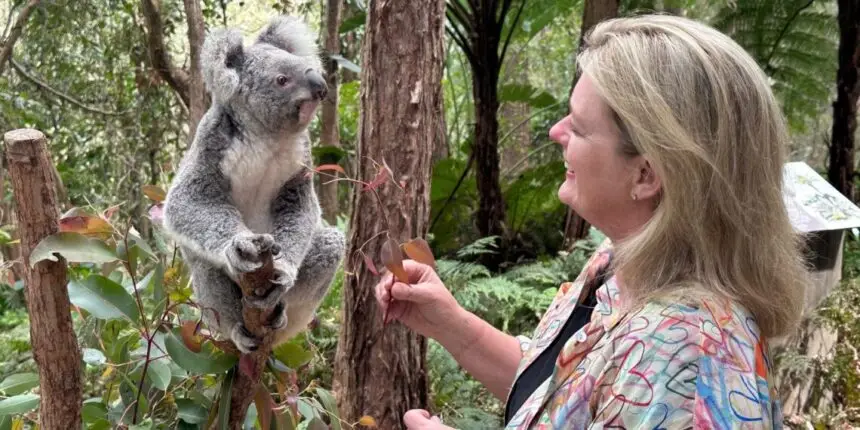
The Australian Koala Foundation (AKF) has welcomed new independent research showing early signs of stabilisation in the Redlands Coast koala population but has warned the species remains at serious risk as habitat loss continues.
Independent studies by the University of the Sunshine Coast and Griffith University found no evidence of further decline in the Redlands Coast koala population since 2018, following more than two decades of significant losses.
AKF chair Deborah Tabart OAM said the findings offered cautious encouragement but should not be interpreted as the crisis being over.
“It is heartening to see Redland City Council’s attempts, but the public need to really know this is not ‘problem solved’,” Ms Tabart said.

Ms Tabart will attend a formal presentation of the research findings and, ahead of the meeting, has prepared maps illustrating landscape changes across Redlands Coast since European settlement.
She questioned whether koala protection efforts were being applied consistently across the region.
“I am wondering too whether Council has ‘cherry picked’ parts of Redlands to focus koala protection rather than recognising the whole of landscape,” she said.
“We are constantly receiving concerns about koalas on Stradbroke Island and in Ormiston, both significant areas for koalas.”
Ms Tabart said it was “gratifying” that there appeared to be agreement on current koala numbers of about 500, but said the broader historical context remained alarming.
“Given some 50,000 koalas have disappeared from Redlands, Logan, Brisbane and Pine Rivers over the last 30 years, it is still a tragic situation,” she said.
The studies estimate there are between 350 and 500 koalas remaining on the mainland, with stabilisation potentially marking a turning point after decades of decline.
However, Ms Tabart warned against complacency, particularly from governments and the development sector.
“I do hope that both the Federal Government’s Environment Minister Murray Watt, where the koala is listed as Endangered, and the development industry do not see this as open slather for other areas of Redlands that are still under constant threat of development,” she said.
“I would like to see more oversight from Mr Watt.”
The AKF said ongoing habitat protection and landscape-wide planning would be critical if the Redlands Coast koala population is to recover rather than merely plateau.