
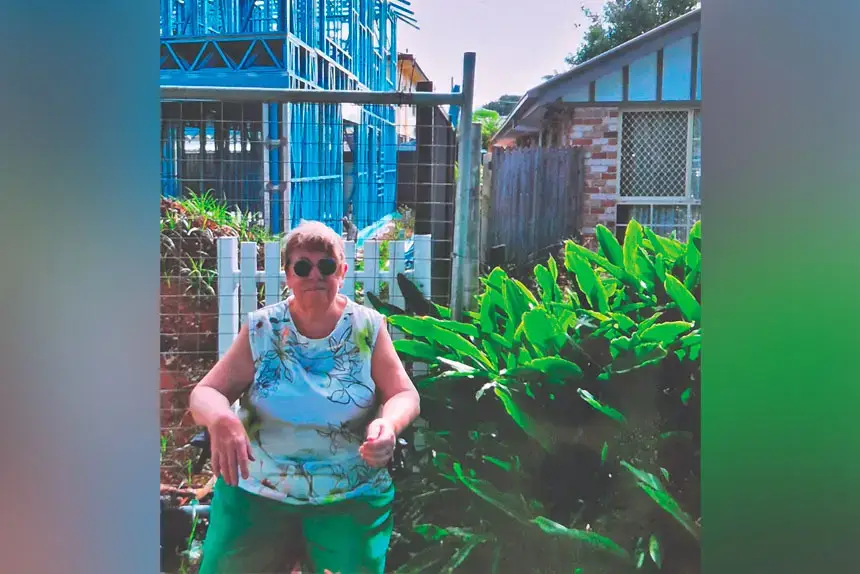
A REDLAND Bay pensioner has concerns that a newly constructed two-storey house next to her home will significantly reduce sunlight, privacy and the effectiveness of her solar panels.
Resident Maudey Hair said she was “bewildered and shocked” when a structure more than 5.2 metres high went up beside her property in James Street just before Christmas.
Ms Hair said she had previously been told by a neighbour that the development at 179–181 James Street would be a granny flat.
However, she said the scale and placement of the building came as a shock, particularly given its proximity to her northern boundary.

“I do not have the funds to fight this in court,” she said.
After visiting a council office at Victoria Point Library on December 22, Ms Hair obtained details of the approved plans and constructed a physical model to better understand the impact on her home.
“The result was the shading effects are horrifying,” she said.
“My home will be shaded along all of my north wall and part of my roof for the whole of winter, and parts of autumn and spring.”
She said the loss of sunlight would render her solar panels “redundant for half to two-thirds of the year” and block sky views from three western-facing windows.
Ms Hair alleged the builder had ignored guidance contained in The Design and Siting Standard for Duplex Housing, which was provided to her by a Redland City Council representative.
She cited provisions requiring buildings to provide adequate daylight and ventilation to neighbouring properties and to avoid adverse impacts on amenity and privacy.
While acknowledging the need for more housing, Ms Hair said development should not come at the cost of existing residents’ liveability.
“I am very aware of the need for more homes — two of my three children are renting and feel like they will never own their own homes,” she said.
“But this does not need to reduce the liveability of those in adjacent dwellings.”
A Redland City Council spokesperson said the subject site was in an area zoned medium density residential, which allows for a mix of single homes and higher-density housing, including townhouses, duplexes and low-rise apartments.
The spokesperson said the design and siting of dual occupancy residential development in Queensland was assessed against the Queensland Development Code, which is administered by the Queensland Government.
“The Code includes both Acceptable Solutions, such as quantifiable standards like setback distances, and Performance Criteria, which are qualitative statements that allow for alternative designs,” the spokesperson said.
“It is not mandatory to adopt the Acceptable Solutions.”
Where a development does not adopt all Acceptable Solutions, the application must be referred to the relevant local government for assessment against the corresponding Performance Criteria, as required under the Queensland Government’s Planning Regulation 2017.
“In relation to the subject site, the application was referred to Redland City Council as it did not adopt the Acceptable Solutions relating to front, side and rear boundary setbacks,” the spokesperson said.
“Each referral to Council is assessed on its own merit, and in this case, the development was deemed to comply with the corresponding Performance Criteria within the Code.”
The spokesperson said Council was not required to assess the development application in relation to building height.