




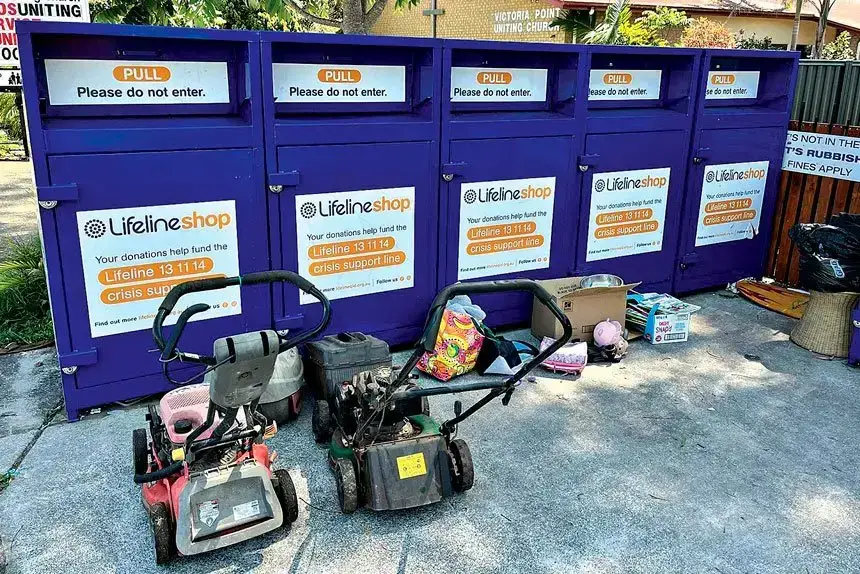
CHARITY workers in the Redlands and Bayside are being forced to deal with dangerous waste as illegal dumping at donation bins continues to grow.
Despite residents having access to subsidised or even free tipping at local waste and recycling centres, increasing numbers of people are abandoning items that clearly do not belong in donation bins.
Victoria Point has been a particular hotspot, with everything from lawnmowers to engine parts dumped at Lifeline collection points.
Many of these items still contain oil or fuel, creating hazards for staff and volunteers tasked with sorting.

The problem is placing unnecessary strain on charities, which rely on community goodwill to deliver essential services.
Instead, they are being burdened with disposal costs and safety risks caused by inappropriate donations.
Community leaders say the trend shows a troubling disregard for both charitable organisations and the broader community, which collectively funds waste management services designed to provide accessible disposal options.
Charitable Reuse Australia chief executive Omer Soker said charity shops remained highly effective at turning quality donations into social and environmental good but needed the community’s support to stamp out dumping.
“Every year, Australians’ generous donations help raise almost $1 billion for social good, divert 190,000 tonnes from landfill and save 1.4 million tonnes of CO₂ emissions, with an impressive 86 per cent of all donations reused,” Mr Soker said.
“We’re encouraging Australians to Make a Good Deed Great by ensuring their donations are quality items, given instore or inside bins – never left outside where they may be damaged.
“The more quality donations we receive, the more good we can do together.”
Division 3 Councillor Paul Golle said misuse of donation bins was becoming a serious problem across the city.
“These items are not only inappropriate for families in need but also create serious safety and operational challenges,” Cr Golle said.
“Even with regular truck pickups, there is no practical way to legislate against these irresponsible and thoughtless acts.
“If residents aren’t sure what items are suitable to donate, the telephone number on the bins is clearly visible and they can call to ask.”