



LEADERSHIP in local government is often a balancing act – one foot firmly planted in the needs of the community, the other reaching for opportunities that shape a better future.
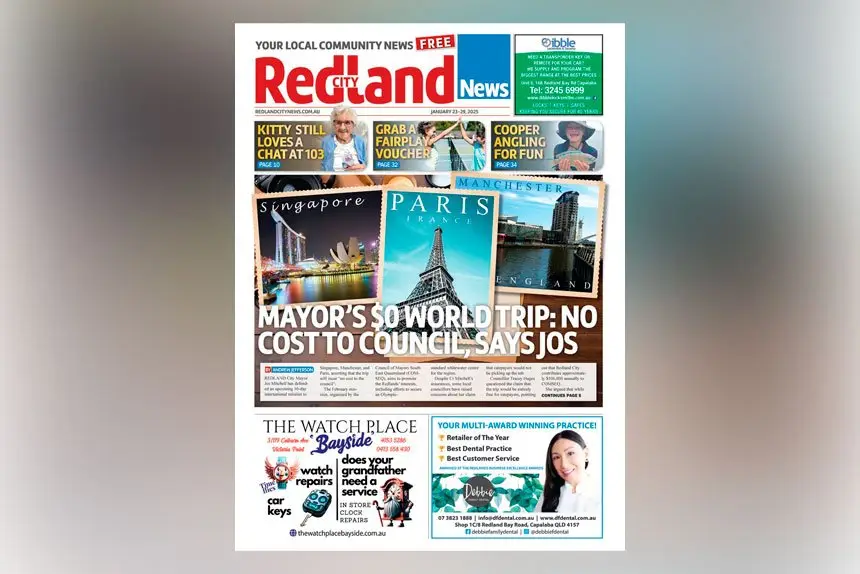
For Redland City Mayor Jos Mitchell, who voted against the proposed whitewater centre, that balancing act was on full display during her recent participation in a 10-day international mission aimed at learning how global cities are leveraging the Olympic Games to deliver lasting benefits.
The mission took in Singapore, Greater Manchester and the Paris region – all cities with significant lessons to offer in areas like transport, housing, infrastructure and urban renewal.
These are not abstract issues for Redlanders.

They’re the bread-and-butter challenges that residents deal with every day, whether it’s traffic congestion, housing supply, or access to essential services.
But while the international learnings are important, so too is the local response to how such trips are funded.
Ratepayers are right to ask questions – and elected officials must answer them.
That’s why Mayor Mitchell’s open and direct clarification regarding the costs of the trip deserves to be acknowledged.
In response to concerns raised at the December General Meeting, Mayor Mitchell confirmed there was no cost to Council for her participation in the delegation.
Her travel expenses were covered by COMSEQ as part of Redland City’s membership, and she personally paid for her return journey and incidental expenses.
“There was no cost in relation to any sandwich – I paid for those myself,” she stated, a line that disarms cynicism with a touch of humour and a lot of clarity.
Yes, the cost of her Executive Officer’s attendance was covered by Council – and this, too, was disclosed.
Most expenses were externally funded, and the Mayor ensured no personal costs were passed on to ratepayers.
It’s easy, in the current climate, to default to cynicism.
Council travel can raise eyebrows, and public spending is under the microscope.
But we must also recognise when our leaders are making the effort to do things differently – and to do them right.
This mission wasn’t a junket.
It was a strategic investment in learning from cities that have successfully used the Olympic and Paralympic Games to drive long-term improvements in housing, transport and liveability.
In Singapore, delegates examined cutting-edge waste management systems and digital infrastructure.
In Greater Manchester, in my home country of England, they explored housing investment models that have revitalised inner-city precincts and improved transport outcomes.
And in Paris, they observed how the 2024 Olympics are being used as a springboard to overhaul the city’s public transport network.
These are the kinds of insights that can inform Redland City’s own long-term planning as Brisbane 2032 approaches.
Ultimately, what’s at stake here is trust.
Trust that elected leaders will act in the public interest.
Trust that ratepayer funds will be used responsibly.
Trust that the community will be told the full story – not just when it’s easy, but especially when it’s not.
Mayor Mitchell has taken steps to uphold that trust, showing that it’s possible to pursue bold, outward-looking initiatives while staying firmly accountable to the people who elected her.
If we want Redland City to be part of a world-class Olympic legacy, then our leaders must be empowered to engage with the world.
And if that’s done with transparency and fiscal responsibility – as this mission appears to have been – then it’s not just good governance.
It’s leadership worth supporting.