



In 1958, Australia recognised the first Sunday of September as Father’s Day. It honours fathers, father figures, fatherhood, and gives us the opportunity to celebrate our own father.
For me, Father’s Day recalls memories of my dad who dealt with challenges through his life with dignity. A trait he passed to me and my sisters.
This is his story.
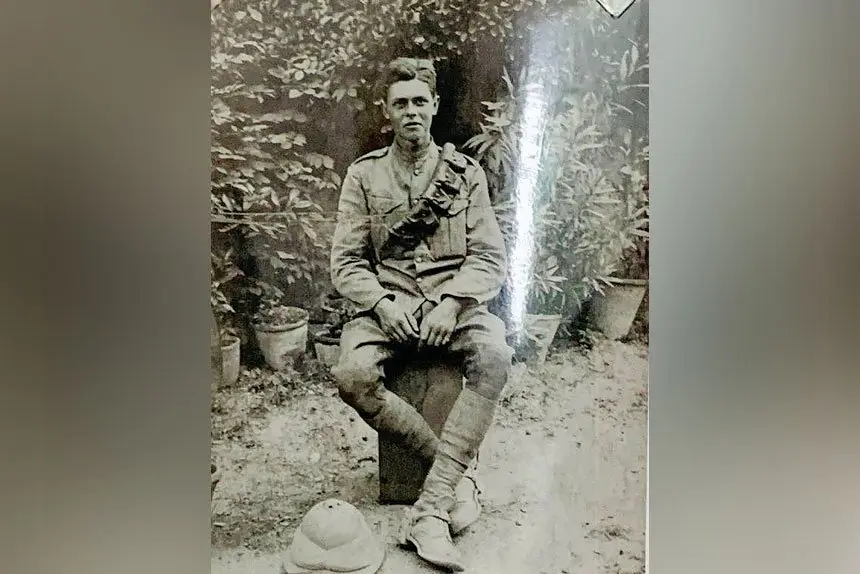
England. WW1. The excitement of war. The unbelievable reality.

The age criteria for overseas service was eighteen but, like me, thousands of young men volunteered, put our age up, were given three months training, and sent to war.
I was deployed to the King’s Own Yorkshire Light Infantry Regiment Army Service Corps working with the mules, taking supplies to the front lines and returning with the injured. Many times laying the mules down to avoid being shot.
In 1922, I immigrated to NZ and was employed as a farmhand. Later I married and raised a family. Those early years were a struggle.
During WW1, the New Zealand Government decreed that soldiers returning from overseas service would be given the opportunity to settle on farms, with cheap loans. As a returned serviceman I was allocated a small farm.
We were making headway, when being English not NZ, we were immediately evicted. My farm was allocated to the son of the person who reported me.
We rented a property bordering the local cemetery. Here I dug graves by hand for extra money.
Unfortunately, the house was full of mildew. I succumbed to asthma, later ending up in hospital and, with no income, had to sell my stock and move to my in-laws farm.
Here my wife and two of our daughters spent two wet and bitterly cold winters in a tent because my mother-in-law refused to allow us in her house. The two older girls were more fortunate.
For income, I snared rabbits and cured their skins for sale. Sold linen door-to-door and with my father-in-law, cut timber from his Kauri forest and sold it.
Eventually, I was employed as a farm labourer at £3.5s a week, a free house, plus a two-quart billy of milk each morning. Asthma was still a problem and my sister sent me medication from England which, after some time, worked. I never suffered another attack.
Later, we moved to suburbia where I managed a dairy/milk run, eventually owning it. While there, we purchased two acres in the country and when the business was sold, we resided there.
Our final move was to a beach-side town.
Throughout Dad’s seven-days a week working life, his days began at 1am and ended at 9pm with an hour’s rest in the afternoon. My father lived for ninety years.
He could barely see but still cooked his meals. He wasn’t ill. He just wore out. My Dad had many setbacks but met each day positively and I never heard him complain.
He lived a life to be proud of.