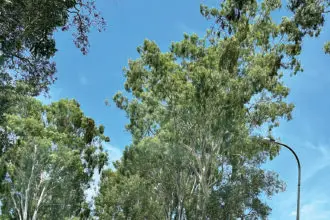




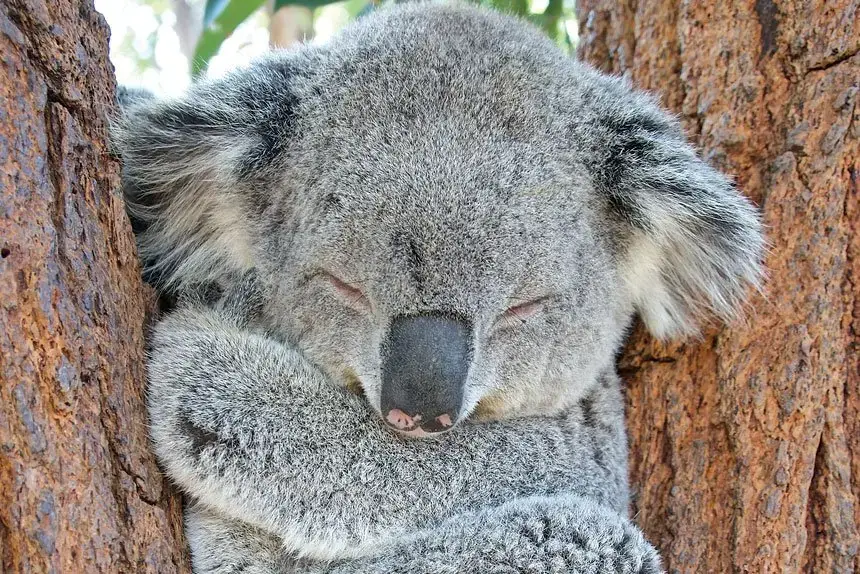
On a farm in southern Queensland’s Darling Downs, a koala lazes in a poplar box tree, resting from the heat.
Around its neck, the marsupial carries a tracking collar.
It’s one of dozens being followed across the cropping region as researchers measure numbers ahead of the arrival of Inland Rail, part of the so called Australian Inland Railway Expressway.
“We’ve got koalas that literally just live in a handful of trees and then others that will go 15 to 20 kilometres and cross two km of wheat fields to get to their next tree,” says Ben Allen from the University of Southern Queensland.

“When the trees are few and far between, individual trees become really, really important.”
What’s unusual about this project is that the tag on the endangered animal was originally designed for cattle.
“We’ve got something that’s made for livestock … but it has huge potential application for people who work with hard-to-work-with animals, like wildlife,” Associate Professor Allen says.
The information will also help farmers work out which trees they should plant and retain to help the koala’s survival.
“It helps them to identify which trees are and aren’t important on their place.
“We’re very keen in getting koala movement data in these very fragmented agricultural cropping landscapes, that is data deficient.”
The koala is one of dozens of animals this Aussie-born cattle tech has been applied to.
“What we’re trying to do is take something that’s made for a cow and stick it on all sorts of weird animals around the place and see how they go,” Prof Allen says.
Yet the solar-powered tag hasn’t worked for all animals, including those that are nocturnal.
Designed by CSIRO and launched in 2021 the Ceres Tag tracks an animal’s location via satellite and is valued for its small size.
Founder David Smith says the tech was designed to help cattle producers back up environmental and paddock-to-plate claims.
“We wanted to prove the animals were moving around on the land and where the improvement was happening,” Mr Smith says.
And cattle producers are also using it to comply with new European Union legislation that bans imports from deforested land.
“When the animal comes in for processing, all of the areas they’ve been to comes up on screen – if it hasn’t been in deforested areas it can be eligible for the EU,” Mr Smith says.
“We’re operating in 36 countries and over 7 million data points directly from satellite.”
From dingos to giraffes and black rhinoceros, the tag is being used on animals that are typically hard to catch.
“Sometimes they’ve worked really well and then other times they’ve been useless, which is not not unusual in a wildlife setting,” Prof Allen says.
Half a world away, Julian Fennessy runs the Giraffe Conservation Foundation in Namibia where he uses the tag to protect the planet’s tallest animal.
Over the past century the giraffe has been listed as extinct in seven African countries.
“We figure out where it is a safe area to bring the giraffe back,” he says from Namibia
“They (tags) are awesome in helping us getting long term data.”
The tags allow conservationists to monitor the animal extensively in the area they’ve been relocated.
The Australian born co-founder of the foundation says by tracking the animal it can help keep them away from poachers.
Mr Fennessy is one of about 80 conservationists who meet online every few months to discuss the benefits of the technology.
Back in Australia, researchers from the University of Southern Queensland have recently started using the technology on foxes in an effort to control numbers.
So far the results have been promising.