



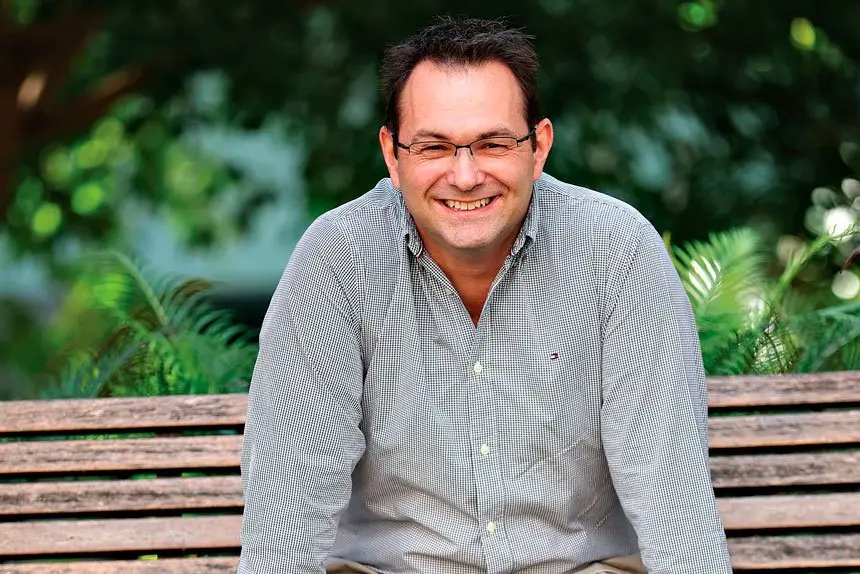
A GUMDALE father-of-two and a Birkdale woman are urging others to prioritise their bowel health after both received shock cancer diagnoses following routine screenings.
Sebastien Nolet, 48, had proactively signed up to the National Bowel Cancer Screening Program after seeing a TV ad and learning a friend had been diagnosed.
“I had a friend, maybe a little younger than me, who was diagnosed with bowel cancer,” he said.
“I also saw the ad repeatedly on TV, so I signed up to receive the test to clear the air, and I’m glad I did.

“When I received the results, it was a bit of a worry … a shock … something I had never expected, and then everything happened so quickly.”
Mr Nolet booked a colonoscopy with Mater Private Hospital Redland gastroenterologist Nadia Maqboul the following week.
“When I woke up, Nadia was there to break the news,” he said.
“She had already booked a meeting with the surgeon, and within 48 hours I was being operated on.
“In my head, I only had cancer for two days.”
Dr Maqboul said Mr Nolet’s story highlighted the importance of those aged 45 to 49 taking initiative and signing up to the National Bowel Cancer Screening Program, which operates as an opt-in setup for that age group.
“We’re seeing this global phenomenon of increased colorectal cancer rates among young people – so people under the age of 50 – and interestingly, Australia has seen the highest rate of increase,” Dr Maqboul said.
“We also know that if found early, more than 90 per cent of bowel cancer cases can be successfully treated.
“So, by lowering the age eligibility of the national screening program, we’re raising awareness and increasing our chances of early detection.
“If we also extrapolate from data we have of the older population, we’ll eventually see improvements such as improved mortality and improved five-year survival rates among this younger demographic.”
People aged 50 to 74 automatically receive a bowel cancer screening kit in the mail every two years.
Meanwhile, 53-year-old Birkdale resident Vicki Shearer had received hers but hadn’t got around to doing it. It was only during a routine check-up for her type 2 diabetes that she flagged a sudden onset of fatigue, and her GP diagnosed her as anaemic.
“I hadn’t experienced any other symptoms – no bleeding, nothing – but my GP said I must be bleeding somewhere for my levels to drop so severely,” she said.
She was in for an endoscopy and colonoscopy with Dr Maqboul within days, and – as in Mr Nolet’s case – Dr Maqboul was there when she woke up to break the news.
“They drove me across the road from recovery to Queensland X-Ray and gave me a CT scan,” she said.
She was in hospital the next day prepping for surgery.
“They removed the cancer with clear margins, so I’m now cancer free and it’s so nice to know I don’t have to worry about chemotherapy,” she said.
“It was handled so efficiently that there was no time to process and no time to worry – what a whirlwind.
“I was all over so quickly that I jokingly refer to it as the week I had cancer.”