




REDLAND City Council has received a clean audit opinion on its financial statements, but a detailed review by the Queensland Audit Office has also highlighted a number of governance, financial control and information technology issues that still require improvement.
The Queensland Audit Office (QAO) confirmed it had issued an unmodified audit opinion for the 2024–2025 financial year, meaning the council’s financial statements fairly present its financial position and comply with accounting standards.
“We have completed our 2025 financial audit for Redland City Council. QAO has issued an unmodified audit opinion on your financial statements,” QAO Director Megan Manuel said in correspondence to councillors.
“I can confirm that we have not identified significant issues since the presentation of our closing report to the audit committee.”

However, the final management report — which will be formally presented to councillors at next week’s Redland City Council meeting — outlines a series of internal control and system weaknesses identified during the audit process.
IT security controls under review
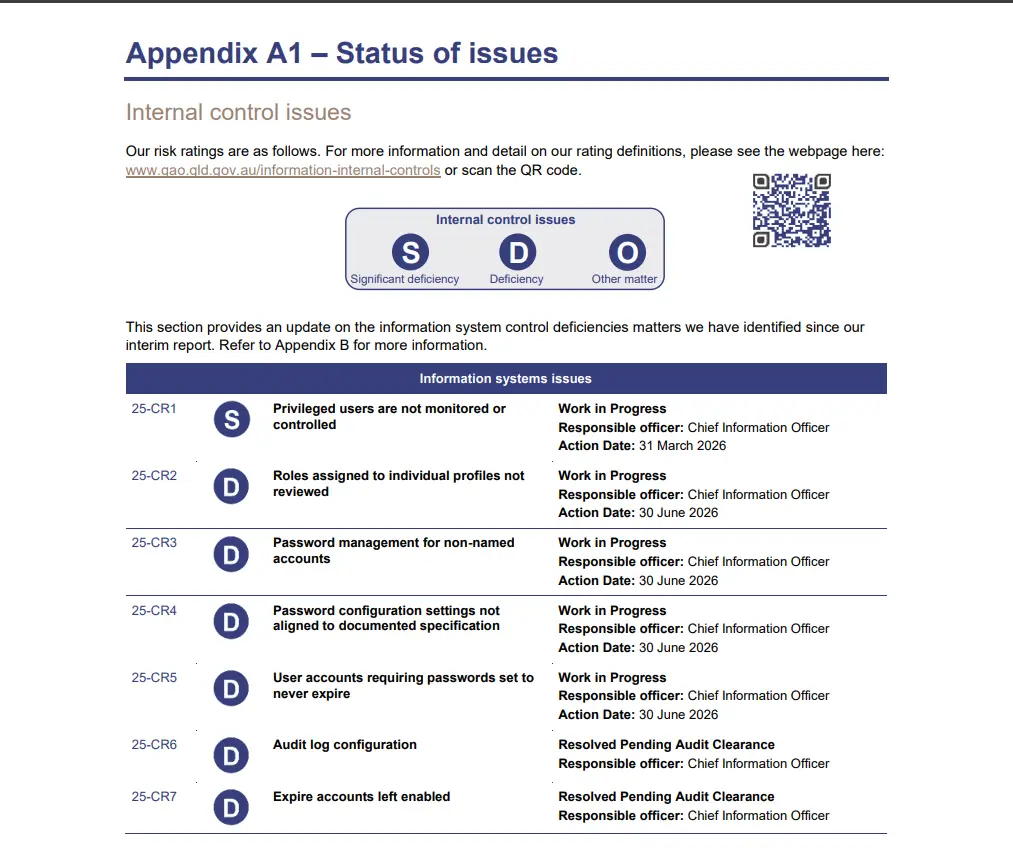
A number of the audit findings relate to council’s information technology systems and access controls.
Among the issues identified were that privileged user accounts were not adequately monitored or controlled, roles assigned to individual profiles had not been regularly reviewed, and some accounts had passwords configured to never expire.
Auditors also found password settings were not always aligned with council’s documented security standards and some system accounts lacked appropriate password management controls.
Council management has committed to addressing the issues, with most improvements expected to be implemented by June 2026.
Asset management review gaps
The audit also found weaknesses in the way council reviews the value and lifespan of its physical assets.
Auditors reported that annual assessments designed to confirm the useful life and potential impairment of assets such as buildings, infrastructure and equipment had low completion rates.
Only 9 of 21 asset data workbooks used to review asset lifespans were completed during the year, while 15 of 19 impairment assessments were finalised.
The report also noted that no Asset and Service Management Plans were finalised during the review period.
Auditors warned incomplete asset reviews increase the risk that depreciation estimates may not accurately reflect the true condition or lifespan of council assets.
Council management agreed with the recommendation and said steps were underway to improve completion rates and documentation of asset reviews.
Payroll and billing control weaknesses
The audit also identified several procedural issues in council’s financial administration.
In one case, auditors found that pay run checklists were not completed at the time of payroll processing, with two checklists later provided that appeared to have been backdated.
Auditors warned that failing to complete payroll control checks during processing increases the risk of errors in staff payments.
Council has since retrained payroll staff and auditors say the issue is now resolved pending final audit clearance.
Another finding highlighted a lack of documented review for council’s quarterly rates billing process, which relies on multiple spreadsheets prepared by finance staff.
While the correct staff were involved in preparing the documents, auditors said there was no formal evidence of a final review before rates notices were issued.
Council has now implemented a formal review step to address the issue.
Contract disclosure delays
Auditors also found council had not published details of awarded contracts over $200,000 on its website since January 2025, potentially breaching the Local Government Regulation.
Council management said the delay occurred while transitioning to a new contract management system, which was completed in August 2025.
Officials said all relevant contracts have now been published and a monthly update process has been introduced.
Grant reporting improvements required
The audit also identified inconsistencies in council’s grants register, which is used to prepare financial statement disclosures about grant revenue.
Although auditors confirmed the financial statements themselves were correct, they warned inaccuracies in internal registers increase the risk of errors.
Council has agreed to introduce quarterly reviews of the grants register to improve monitoring and accuracy.
Audit fee higher than expected
The audit cost $224,744 excluding GST, higher than the originally estimated $195,000.
Auditors said the increase was due to additional work reviewing asset valuations and grant acquittals.
The results of the Redland City Council audit will also be included in the Queensland Audit Office’s upcoming Local Government 2025 report to Parliament, which examines financial governance across councils statewide.
Councillors will be asked to formally note the audit findings when the report is presented at the Redland City Council general meeting on 18 March.