
THE Redlands Performing Arts Centre is hosting Queensland’s first-ever dementia choir, bringing joy and community to people living with the syndrome.
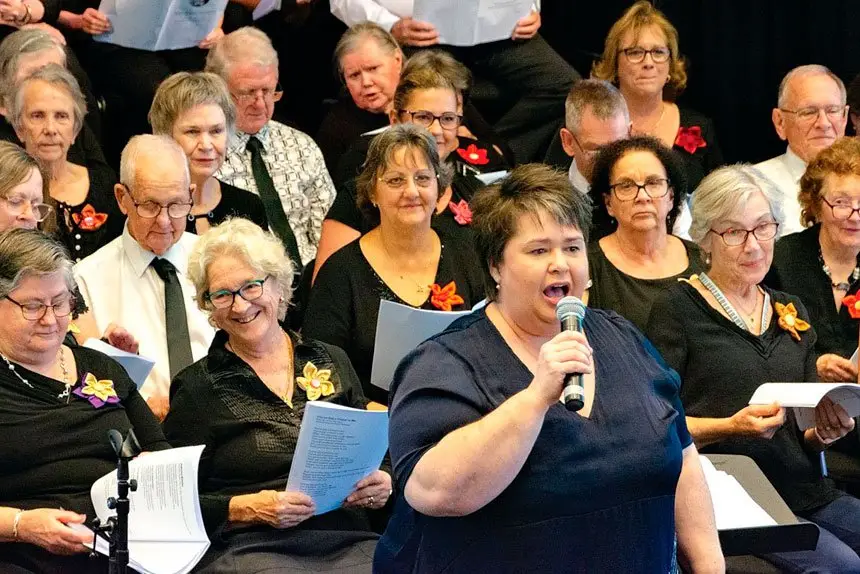
Sing Sing Sing was established in 2021 by choral conductor and voice coach Melissa Gill.
Her father’s diagnosis of vascular dementia and her mother’s experience as his carer inspired and motivated her to start the choir.
“I lived with my parents for a few years after my Dad was diagnosed and I saw the loneliness and isolation,” Ms Gill said.

“He needed a social experience, he needed an opportunity to feel joy … my mother needed an opportunity to connect with other people who understood.”
Sing Sing Sing is more than just a choir, as it offers its members and their carers a way to connect and better understand each other.
“I know from personal and professional experience that a choir can offer connection, community and understanding,” Ms Gill said.
“Everyone has a voice – and finding and using that voice can be a life-changing experience.”
During the past decade, dozens of studies have investigated the effect music has on people living with dementia.
Many have concluded that singing in a group positively effects people living with dementia and can dramatically improve their quality of life.
Trish Vella-Burrows was awarded the Finzi Scholarship in 2009 – funding she has used to explore the role of music in dementia care across the UK, Italy, Sweden, and Barbados.
In 2014, the English researcher published the book, Singing and people with Dementia, and backed with evidence, detailed how group singing could help support people facing a range of challenges arising from living with dementia.
Ms Vella-Burrows’ book found that group singing improved people’s wellbeing, ability to communicate, cognition and understanding, social interaction, organisation skills and physical ability, while also evoking positive memories.
In agreeance with researchers’ findings, Sing Sing Sing has made significant positive impacts to those who participate.
“We often see people come into the room who are withdrawn, but as soon as the music starts, their bodies start to move, their hands start to clap,” Ms Gill said.
“There’s a very physical response.”
Each school term, the choir hosts an end-of-term “Come and Sing with Us” event for family and friends to showcase the group’s hard work.
“Our community of singers create friendships and have opportunities for enrichment through relationships – something that also suffers when someone is diagnosed with dementia,” Ms Gill said.
The Sing Sing Sing choir meets every Monday (10am-noon) of the school term at RPAC, led by professional musicians and supported by two small armies of volunteers.
Entry to sessions is via the stage door.