
IN 1953, the Chevrolet Corvette was the first production sports car to come out of Detroit.
Today, 72 years later, the name lives on in the eighth-generation mid-engined C8 which, in ZR1 trim straight from the showroom, will go from zero to 150mph in under 10 seconds.
Along the way, passionate collectors have hungrily tracked down the special ones: the factory show cars, the development prototypes, cars with triumphant race history, or past celebrity ownership.
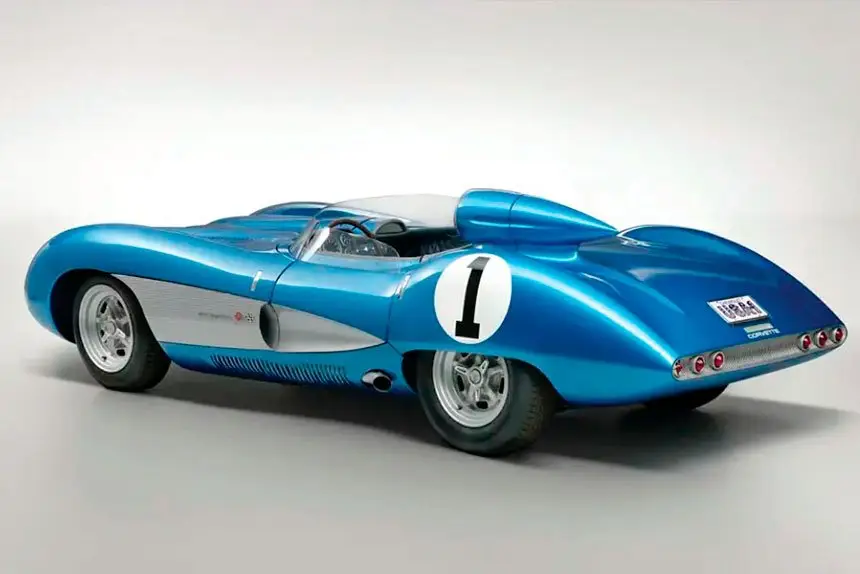
But there is one Corvette they have never been able to buy: Project XP-64. It is a pure factory race car, and the only one in existence.

Since its creation more than six decades ago it has never been sold. It is the holy grail.
Now, after spending long silent years in the Indianapolis Motor Speedway Museum, it will be sold at RM Sotheby’s Miami auction on 27-28 February.
The guide price is between $5 million and $7 million.
The story of XP-64 is inextricably linked with one man, Zachary “Zora” Arkus-Duntov.
Of Russian-Jewish extraction, he escaped from Europe to the US during World War II and set up in business as an automotive engineer, later racing at Le Mans for Allard and Porsche.
When he saw the original six-cylinder Corvette at General Motors’ Motorama show in New York in 1953, he realised that its potential was not matched by its performance.
So he wrote to Chevrolet’s chief engineer, Ed Cole, who had overseen the Corvette’s creation, and offered his services to develop and improve the car. Cole hired him at once.
As a man who had raced in Europe and was familiar with British and Italian race car thinking, he brought a fresh perspective to GM’s Americentric approach.
After initial excitement at its introduction, Corvette sales were not doing particularly well.
By 1955, under his direction, the Corvette’s original straight-six had been replaced by a V-8, and roadholding and handling had been improved.
Duntov knew that weight and aerodynamics were major factors in creating a car that could compete with the best that Europe could offer.
As the basis of the car, he wanted a tubular space frame, which would be light and very stiff.
His final design closely followed the frame of the Mercedes-Benz 300 SL.
Before the single XP-64 was completed, a test car was built up – the “Mule” – with the same chassis and suspension under a rough glassfibre body to evaluate all the components.
The whole project, from approval through design and build, was completed in five months.
The Mule was sent ahead to Florida while, inside the truck carrying XP-64 the 1200 miles from Detroit to Sebring, the team worked away to finish as many details as they could.
In the race XP-64 was driven by the experienced American John Fitch and the veteran Italian Piero Taruffi.
It suffered from braking and electrical troubles which could all be blamed on lack of development time.
Stifling cockpit heat within the magnesium shell was also a serious problem.
Eventually the car was stopped by a rear suspension joint failure.
Its racing life was short and unsuccessful, but determined to keep it intact, Duntov offered it to the Indianapolis Motor Speedway Museum, which became its home for the following 59 years.
In 1987 it was refreshed and flown to California for Chevrolet’s 75th anniversary at Monterey.