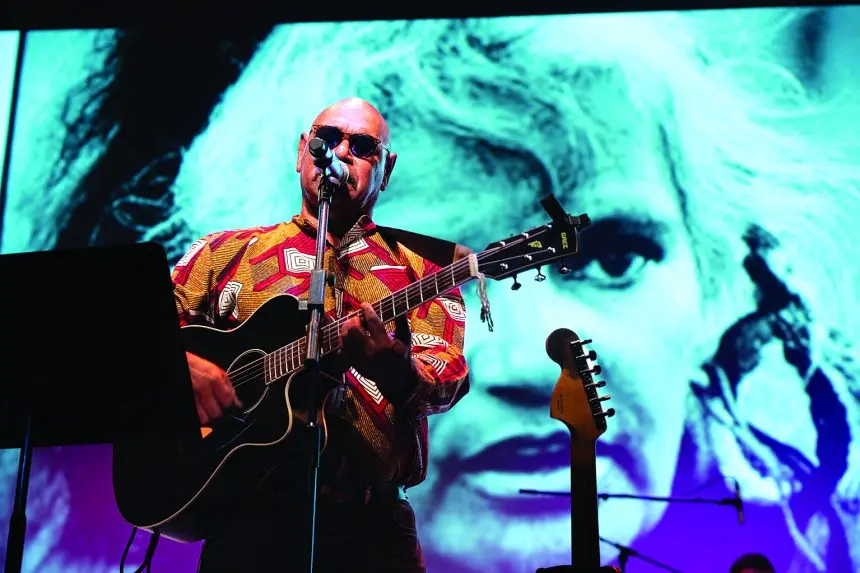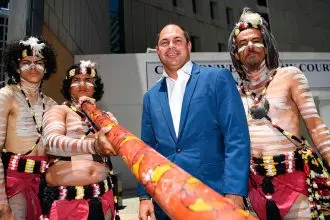
The music of Joe Geia, of Macleay Island is about story-telling, tradition and truth, but more than this, it is a story he has lived.
A Guugu Yimidhirr Kaurareg man, Geia gave an oration on September 12 at QUT as part of his PhD within the School of Creative Arts and what will soon be Australia’s first Indigenous faculty.
This is the third year of the QUT Meanjin Oration, with Geia joining Professor Marcia Langton AO and Indigenous rights champion Noel Pearson as Meanjin orators in support of knowledge and culture and a willingness to share in an open forum.
Also at the forum were Kulkalgal Elder associate professor Phillip Mills, Guwamy woman Cheryl Buchanan and Graham Brady, an Elder of the Kawanji clan group of Western Gu Gu Yalanji Cape York and son of Pastor Don Brady who was critical in the formation of the Brisbane Blacks movement.
Geia said he started touring his Rations to Wages to Treaty show which tells the stories of these three eras. The show includes background photos and personal paintings. The show also features a song written by his father, Albie Geia who was among seven Palm Island leaders who led a strike in 1957, protesting for wages instead of payment in sugar, flour and tea. Other songs are about his mother who was taken from Cooktown to Palm Island at age seven, land rights, assimilation, protectionism and having a voice.
“I always wanted to write a book about this journey and by the time I have finished the PhD, there will be enough writing to do this,” Geia said.
Geia’s wife Lyn said it was an honour for Joe to tell his story.
“Most people don’t really know the history of Australian people. His Rations to Wages to Treaty show tells the story of significant times and people. It is a big honour to Joe to be respected as a leader,” Lyn said.
Geia said song, dance and art would continue to play a pivotal role in communication for Indigenous Australians.
“Before colonial settlement, there were about 500 dialects of Aboriginal language,” he said.
“And out of all that language, there was no documentation. The way we communicated with the other 499 was through song, dance and art.
“Our art and our music-making today, that’s in us. Because we were a nation of no alphabets.”
Celebrating Indigenous Culture