
RECENTLY, the planets collided to force me into running to the cupboard where I ashamedly store my mother’s old embroidery.
I can’t bear to throw it out and yet I can’t keep up the ritual of replacing it under lampshades, vases and ornaments monthly as she used to.
I’m the woman who, in June 2024, has Christmas cards from 2023 still awaiting a response, so replacing doyleys monthly just doesn’t enter my spectrum at all.
However, with the growing fervour of the countdown to the Paris Olympic games in July and concurrent announcements on 612 ABC’s breakfast program pleading for donations of old doyleys to stitch together as a huge exhibit to pay homage to the artwork of the women of my mother’s generation at this year’s RNA in August, I had to act.

I knew, pining away in that dark cupboard was a piece of embroidery I had to release.
Now, although I bear the guilt of keeping my mother’s embroidery in a dark place, I have over the years made attempts to display her work.
I do some public speaking and as such have equipment I cover with one of her small square table cloths. It is an exquisite piece of white linen with large colourful embroidered flowers and a meticulously crocheted edge. When I remove it from covering my gramophone, I remind those present this is the art of a generation of women rarely recognised.
I respect their skills because I remember my sampler at primary school where all girls had to show how beautifully they could chain stitch, satin stitch and other stitch. My sampler, despite my mother’s skills, took on the demeanour of a used dishcloth, certainly nothing to showcase.
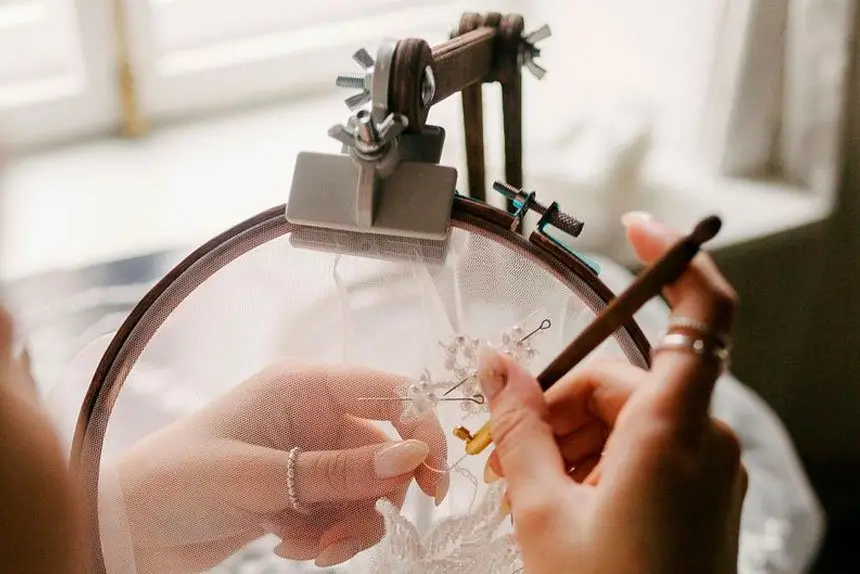
The embroidery needing release from the dark cupboard was produced by my mother to commemorate the 1956 Olympic Games in Melbourne. It was skilful, bright and happy. When I look at it, it not only records the year and event, but it emanates a spirit of its time, a certain naivety.
What I now realise is women, through their embroidery, recorded history. I’m sure there are many important historical events recorded out there on embroidery hiding in some dark cupboard, begging release.
As a six-year-old, I remember my mother working on this piece and I only have one brief recollection of the games. I must have seen it on a Movietone Newsreel, because we didn’t have TV.
I remember when Russia and Hungary went the biff during a water polo match, because of the Soviet army’s repression of an uprising in Hungary. Sound familiar?
And I recall names like Betty Cuthbert, Shirley Strickland, Dawn Frazer, Murray Rose, Jon Henricks and Lorraine Crapp who would become household names instantly.
What I didn’t know at 6 was these Games were the first to be staged in the Southern Hemisphere, and the first to be held outside Europe and North America. Melbourne is the most southerly city ever to host the Olympics.
And, finally, Egypt, Iraq and Lebanon boycotted the 1956 Olympics due to the Suez Canal Crisis following the British-Israel-French invasion of Egypt to control the waterway.
My mother’s embroidery doesn’t record all this, but it records enough. It shows an enthusiasm towards a great event, something that a busy mother-of-seven saw as inspiring enough to spend hours capturing.
Of course, there is a famous precursor to my mother’s attempt to document history through embroidery, a very big brother so to speak, the 11th century, 70m long Bayeux Tapestry, an embroidery that depicts the Battle of Hastings and life at the time of William the Conqueror with awe inspiring detail.
So, what will happen to this piece of art from almost 70 years ago? Well, it can’t return to the cupboard, so I am in the process of purchasing a suitable frame so it will hang on the wall until the 2032 Brisbane Olympics.
Maybe then, just maybe, someone will see its value and air it as a worthwhile historical record captured by an inspired woman in 1956.