
One of Australia’s largest marine conservation projects has so far recycled approximately 800 tonnes of used oyster shells as new homes for juvenile oysters, crabs and fish.
The marine volunteers have a target of 100 hectares of reclaimed oyster beds and they have made significant inroads deploying more than 7,000 reef units into a site donated for oyster bed restoration by the Port of Brisbane.
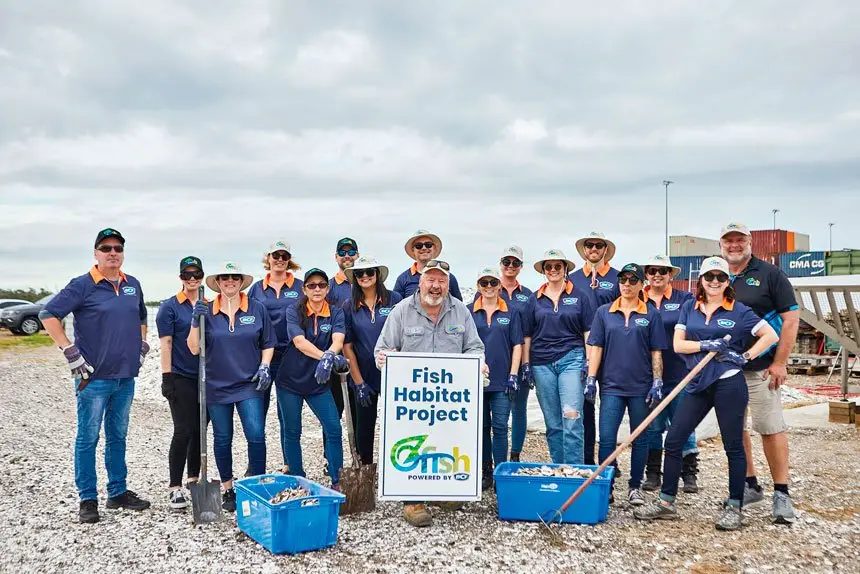
The project is coordinated by Ozfish Unlimited with help from school students and volunteers. For each oyster shell collected from restaurants that is caged and dropped on the seabed, an estimated 10 bay oysters can attach and find a new home.
It is estimated that 97 per cent of Moreton Bay’s oyster beds have been destroyed by harvesting for food as well through as bulk shell collection to make cement.

The scale of this project is staggering. Each restored hectare of native oyster reef can filter 2.7 billion litres of seawater removing 225kg of nitrogen and phosphate- harmful nutrients from polluted runoff. For each hectare of reef an additional 2.5 tonnes of harvestable fish is generated every year.
An this is all happening right on our Bayside doorstep through Australia’s fishing conservation charity, OzFish Unlimited.
Volunteerism is often essential in supporting all types of community programs, and our residents and school students are demonstrating that they are world leaders in marine conservation.
OzFish aims to support Aussie anglers improve their waterways and fishing spots through habitat restoration and conservation. They do litter clean ups and capacity building program along with complex habitat restoration projects like seagrass and shellfish restoration and riparian rehabilitation.
What makes OzFish different from other NGO’s and charities is that they are entirely community driven, built on the passion of recreational fishers and community volunteers, using a bottom-up approach that involves the community taking ownership of the entire restoration process.
A few years ago, a group of Moreton Bay anglers set themselves an ambitious goal to restore 100 ha of shellfish reef in Moreton Bay.
Shellfish reefs are the cornerstone of healthy marine ecosystems and once thrived in Moreton Bay.
However, they are now critically endangered, with 95% of shellfish reefs functionally extinct due in part to poor water quality combined with historical overharvesting and dredging for lime.
The innovative restoration technique has been devised by the volunteers themselves, with the entire restoration process validated by Australia’s leading scientists.
This is a shellfish revolution.
The process begins with the collection of used oyster shells from seafood businesses and restaurants.
These shells undergo a meticulous sanitisation process at the recycling centre in the Port of Brisbane, where they are exposed to sunlight for a minimum of four months before being washed and placed into a purpose-built basket know as a Robust Oyster Basket or ROBS.
The ROBS are triangular prisms made of degradable steel mesh by community volunteers and filled with recycled oyster shells. Containing the used shells in the ROBs creates an engineered structure that mimics remnant shellfish reefs. The mesh takes about two years to degrade, which gives the oysters and other shellfish time to attach to the surfaces and then cement together before the mesh container completely rusts out, leaving only a solid structure of living shellfish.
This innovative design maximises water flow and encourages shellfish accretion, creating ideal habitats for marine life. Each ROB serves as a miniature ecosystem, providing shelter for thousands of baby oysters and other marine life. The system improves water quality – each adult oyster can each filtering 180 litres of water per day.
The proof of the project is in the pudding and the project involves collaborative research by three Queensland universities which are seeking to uncover how much seallife is growing on the ROBS and what sea life is living in and around these structures.
The University partners—Griffith University, the University of the Sunshine Coast, and the University of Queensland—are collaborating on this work, which is filtering into other shellfish restoration projects in Australia.
The research involves pulling apart baskets to count the invertebrates and oysters living on them. These findings are seeing positive results and will be published and shared to inspire more community groups to adopt the OzFish approach to shellfish reef restoration.
The researchers are still crunching the number but have found that the deployed ROBs recruited oysters well, were very stable, inexpensive, portable and easy to deploy, and formed sturdy clumps of oysters in about 12 months.
Another benefit the researchers found is that the restored units recruit multiple reef shellfish species including rock oysters, pearl oysters, and mussels through wild occurring shellfish larvae in the area. This type of species diversity will build resilience and long-term self-sustaining reef structures. Because ROBs rely on the natural recruitment of spat (rather than purchasing spat from hatcheries), this restoration technique can be widespread, which is why other OzFish groups are now replicating the pioneering system across the country.
The site has been donated for restoration by the Port of Brisbane. The project has so far diverted 800 tonnes of used oyster shell from landfill. OzFish hopes the rapid rise of shellfish reef restoration and support from community volunteers is the beginning of a new era for Moreton Bay conservation and large-scale marine restoration in Australia.
Applause should be given to the volunteers supporting the project. The communities that surround Moreton Bay have helped construct it, and in return benefit from it, with endless opportunities for work, education, and recreation.
They are leading the environmental charge and showing off some fair dinkum Aussie smarts in the world of marine conservation. You can join Ozfish to help. Volunteers are welcome at two community working bees a month to build the ROBS. Visit the OzFish website to sign up and give it a go
To volunteer or learn more about Ozfish go to ozfish.org.au