
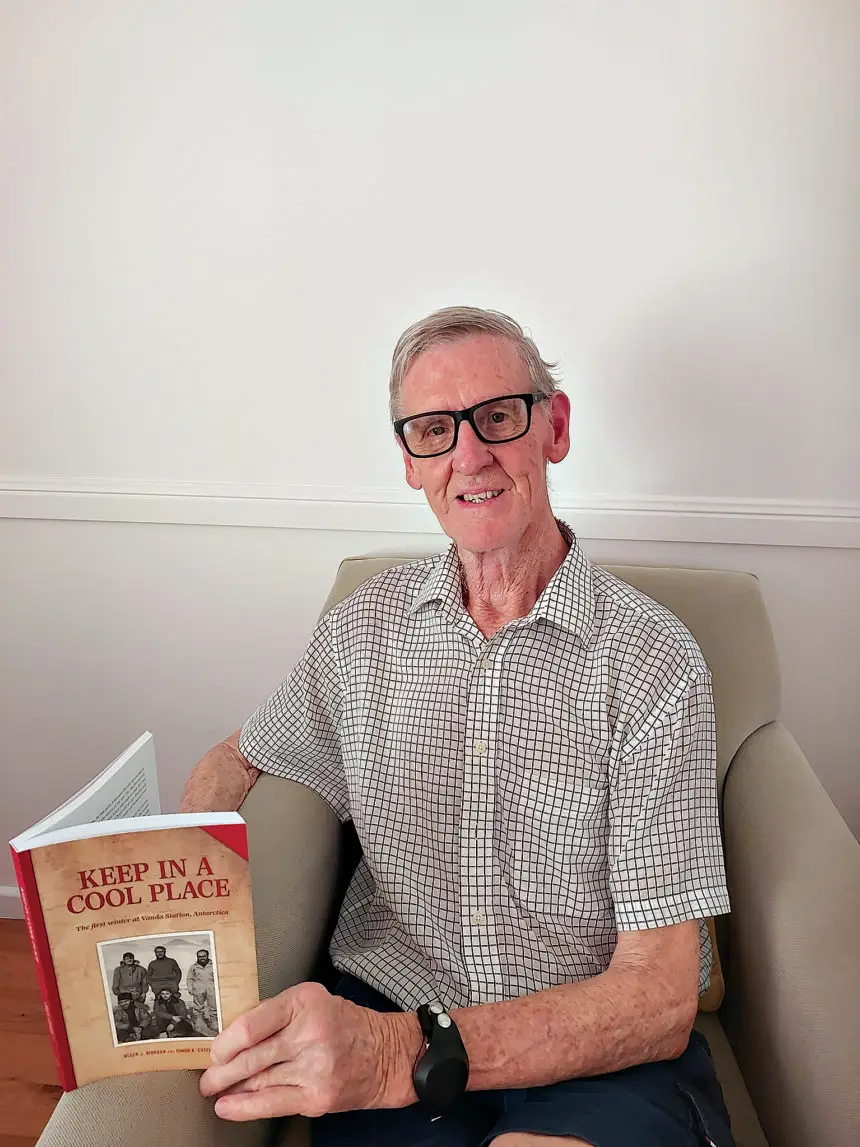
A MEMOIR recounting a groundbreaking year in Antarctica has earned international recognition, with authors Simon Cutfield and American exchange scientist Allen Riorden receiving the prestigious Louis J. Battan Author’s Award from the American Meteorological Society in Houston, Texas.
Their book, Keep In a Cool Place: the first winter at Vanda Station, Antarctica (Canterbury University Press, 2022), chronicles the first winter spent at Vanda Station in 1969 — a venture that pushed scientific and human endurance to its limits.
Now retired and living in Cleveland, Mr Cutfield was one of five men who overwintered at Vanda Station, located on the shores of Lake Vanda in Antarctica’s Dry Valleys — about 160 kilometres from Scott Base and McMurdo Station on Ross Island.
The station also lay within reach of Mount Erebus, the world’s largest active volcano, rising 3,749 metres above sea level.

At the time, Mr Cutfield was a recent science graduate from Auckland University.
His role was to help install and operate scientific equipment at the newly established base.
“It was ground-breaking work and a great experience,” he said.
The memoir details eight months of total winter isolation, during which the team faced unknown weather conditions, fuel shortages and unexpected challenges across a range of scientific programmes including meteorology, hydrology, seismology, earth currents and geomagnetism.
Lake Vanda itself proved to be one of the expedition’s most fascinating subjects.
Measuring 6.4 kilometres by 1.6 kilometres, the lake was capped by three to four metres of ice.
At a depth of 68 metres, the water temperature reached an astonishing 25 degrees Celsius.
“It was discovered that the ice caps acted as an insulator for water that was solar heated in the summer,” Mr Cutfield said.
During July, temperatures plunged to minus 57 degrees Celsius.
The team became the first to witness aurora in the Dry Valleys and listened via short-wave radio as the Apollo moon landing unfolded in July 1969 — a moment linking their frozen isolation to one of humanity’s greatest achievements.
The station’s four prefabricated dongas were erected in late 1968, with all facilities and supplies transported either by overland tractor train from Scott Base or flown in by helicopter.
The structures were eventually removed in 1991 as Lake Vanda’s water level continued to rise.
Mr Cutfield said the idea for the book was sparked by a reunion in 2008.
“It was easy to write as we had both kept our diaries from that year,” he said.
The award citation praised the memoir as “inspiring to readers of all ages to appreciate the complexities of Earth’s natural systems and dedication of the scientists who uncover their mysteries.”
Mr Cutfield hopes the account of what he describes as a truly memorable and historic year will inspire future scientists and adventurers.
Following his return from Antarctica, Mr Cutfield spent 30 years working as an engineer in Australia’s mining industry.
Today, he volunteers at the North Stradbroke Island Museum, which he describes as “a place of interest”.
“I enjoy the friendly environment. I am currently digitising old photographs and documents. Some are more than 100 years old,” he said.
A copy of the book is available at the Cleveland Library.