
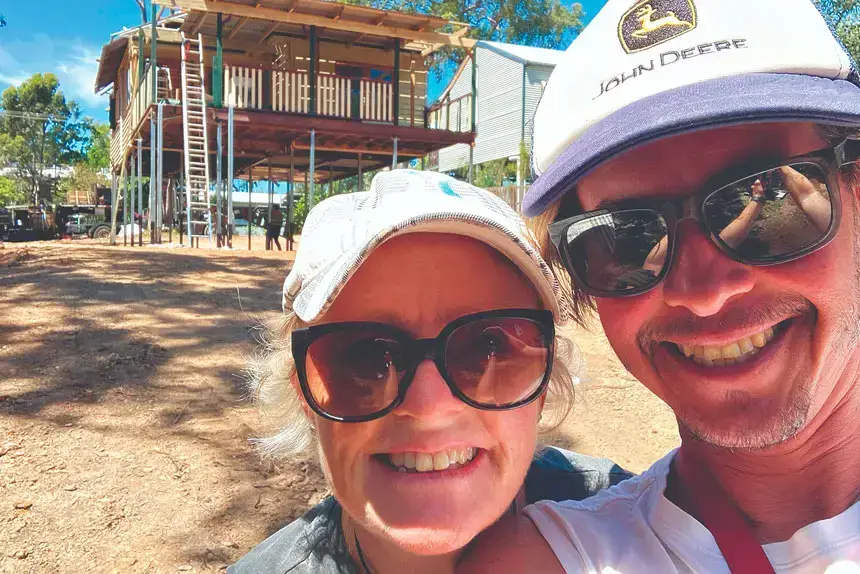
FOR Miguel Angel Andujar, Venezuela is never far from his thoughts.
Though he now lives a quiet life on Macleay Island, surrounded by the tranquillity of Moreton Bay, his heart remains tethered to a country in turmoil.
Miguel left Venezuela decades ago, a young journalist and actor forced to flee after repeated threats to his life.
“One day, a SWAT team showed up at my house with long guns,” he recalls.

“My mom said: ‘I think that’s enough. You better go somewhere else.’
“That’s how I ended up in Australia.”
He remembers Venezuela in the 1980s as a “paradise,” blessed with vast natural resources and one of the world’s top oil reserves.
The country thrived economically and culturally, with strong international relationships and a sense of national pride.
“It was one of the seven biggest producers of oil in the world,” Miguel said.
“We had the resources, the talent, and the energy.
“It was a place blessed by nature and opportunity.”
But political upheaval changed everything.
The rise of Hugo Chávez, followed by Nicolás Maduro, disrupted decades of stability.
International alliances shifted from traditional partners to countries like Cuba, Iran, and Russia, driven by ideological alignment rather than economic pragmatism.
Venezuela, once a beacon of prosperity, plunged into political and economic chaos.
“Everything went to hell,” Miguel said.
“That’s one of the reasons I had to leave.”
Miguel arrived in Australia with few possessions and a determination to rebuild his life.
His first job?
Cleaning hotel rooms for nearly a year.
Like many immigrants, he worked his way up from humble beginnings, eventually earning Australian citizenship and establishing a life far from the dangers he fled.
Yet despite the years and distance, his connection to Venezuela has never waned.
The recent political upheaval — including the removal of Nicolás Maduro from power — has stirred a mix of emotions.
Miguel describes the situation as “very tense,” relaying daily reports from his mother in Caracas, where she has witnessed chaos firsthand.
“There are long queues for food, intermittent electricity, and shooting in the background,” he said.
“People are sheltering in alleys, expecting potential attacks.
“I hear it every time I speak to my mom — rat-a-ta-ta, pa-pa-pa.
“That’s the background noise now.”
His mother, in her 60s, has taken extraordinary measures to survive.
She fled her apartment near a government hot spot to a small, crowded unit in a nearby town with neighbours and their dogs.
During blackouts, she cooks meals on a coal-filled pot on the balcony, sharing food with others to avoid waste.
“Everyone is doing what they can,” Miguel said.
“It’s a small act of humanity in the middle of chaos.”
The uncertainty extends beyond daily life.
While relief exists that Maduro is no longer in power, Miguel worries about what comes next.
“Happy initially because a big problem is out, concerned because the resolution is not complete,” he said.
“No one is in charge, and armed groups can shoot people with impunity.
“Permanent stress… every time my phone makes a notification, I jump.
“I’m permanently scared.”
For Miguel, the fear is not abstract.
Cuban security personnel sent to protect Maduro were among the first casualties in recent clashes.
He describes them as a “Kamikaze ring of security,” sent to protect the president under threat of death to themselves or their families.
It is a stark reminder of the human cost of political machinations and foreign intervention.
Miguel views the US-led removal of Maduro as justified, noting the care taken to avoid civilian casualties.
Yet he acknowledges the complexity of the situation.
“Some see it as necessary to end the dictatorship, others see it as overreach,” he said.
“I think the actions were fair, considering what was at stake.
“But the consequences on the ground are still very real and very dangerous.”
His perspective is shaped not only by fear but by experience.
As a journalist in Venezuela, Miguel covered protests and civil unrest, often at great personal risk.
The exodus of professionals from Venezuela — an estimated nine million people — is a loss he has witnessed firsthand.
Many friends, forced to leave, are now scattered across the globe, leaving a country drained of talent and hope.
Yet despite the fear and displacement, Miguel’s story is one of resilience and hope.
He urges Venezuelans in Australia to stay engaged and support those still at risk back home.
“Stay strong and provide as much international support to your families in Venezuela as possible,” he said.
“Make noise about what’s happening. Don’t let it be forgotten.”
His mother, the sole remaining family member in Venezuela, represents both the fragility and endurance of life amid chaos.
“She’s been through a lot,” Miguel said.
“Last year she battled cancer, and now this year we start with bombs.
“I haven’t been able to hug her in seven years because of the danger.”
His reflections extend to the broader challenges Venezuela faces.
Political change, economic recovery, and social peace are not just aspirations; they are necessities for a nation scarred by decades of mismanagement, corruption, and conflict.
“A lot of work needs to be done,” Miguel said.
“The problem isn’t over. The solution has only just begun.”
For Miguel, hope is personal and deeply rooted in family.
“Optimism is limited but I dream of one day returning to my country,” he said.
“I want to sit at a table with my mother, speak my language, eat my food.
“That’s my only hope.”
“It’s simple, but it’s everything.”